
Showing posts with label anti-war crazies. Show all posts
Showing posts with label anti-war crazies. Show all posts
Friday, March 28, 2008


Monday, January 21, 2008
Monday, June 04, 2007
Retired US Army Gen. Ricardo Sanchez : Forget About "Victory" in Iraq
An Update on the "Worst President in US History"TM


Ricardo Sanchez, the man who led US and coalition forces during the first year of the occupation of Iraq says that the very idea of "victory" in this war is impossible. Like the Iraq Study Group report, Sanchez called the situation there "bleak" and blamed it on “the abysmal performance in the early stages and the transition of sovereignty.”
I think if we do the right things politically and economically with the right Iraqi leadership we could still salvage at least a stalemate, if you will — not a stalemate but at least stave off defeat.
In an interview with the French news agency AFP -- his first interview since retiring last year -- Sanchez took a dim view of American political and military leadership.
I am absolutely convinced that America has a crisis in leadership at this time. We’ve got to do whatever we can to help the next generation of leaders do better than we have done over the past five years, better than what this cohort of political and military leaders have done.
What is interesting about this story -- aside from its overt content -- is the fact that the first and one of the dominant military commanders during our occupation of Iraq is interviewed in San Antonio, Texas, by a major global news agency (an agency that US media use all the time), that he makes a statement like this, and no US media outlets are publishing it. As of this writing, I have found this story on only the following websites:
The Khaleej Times (United Arab Emirates)
Middle-East On-line (United Kingdom)
Focus News (Bulgaria)
Dispatch Online (South Africa)
News 24 (South Africa)
Independent On-Line (South Africa)
Daily Times (Pakistan)
Alsumaria (Iraq)
Gulf Times (Qatar)
Peninsula On-Line (Qatar)
Alalam (Iran)
I guess that the "liberal" media are trying to hide this story for some nefariously "liberal" reason.

Meanwhile, following the first two-month period of our occupation during which more than 100 Americans died in each month (104 in April and 127 in May -- the third highest number of US deaths in the 52 months since the invasion), another 14 Americans were killed in Iraq today, bringing the total for the first four days of June to 31.
CAN WE IMPEACH HIM NOW???
Sunday, May 27, 2007
Commencement Round-up: Former Bush Chief-of-Staff Andrew Card Booed Off Stage at UMass; Cheney at West Point Says "Screw Geneva Conventions"
Both grads and faculty wore signs protesting Card's presence. One banner read "Criminals go home." The theme of the day was "Honor grads; Dis-Card."
Beautiful.
Meanwhile, Vice President Dick Cheney told graduating Cadets at West Point that the Geneva conventions should not apply to the (so-called) "war on terror." This comes at a time, bizarre and surreal, that West Point instructors are having difficulty persuading cadets that US soldiers ought to be better than terrorists.
Recently, West Point instructors have complained of the difficulty of persuading Army cadets to adhere to the principles of the Geneva Conventions in the war on terrorism. A February article in the New Yorker highlighted a dialog on the problem between West Point's dean and Joel Surnow, producer of the hit Fox television program '24.'
"This past November, U.S. Army Brigadier General Patrick Finnegan, the dean of the United States Military Academy at West Point, flew to Southern California to meet with the creative team behind '24,'" wrote Jane Mayer in the magazine. "Finnegan, who is a lawyer, has for a number of years taught a course on the laws of war to West Point seniors - cadets who would soon be commanders in the battlefields of Iraq and Afghanistan. He always tries, he said, to get his students to sort out not just what is legal but what is right. However, it had become increasingly hard to convince some cadets that America had to respect the rule of law and human rights, even when terrorists did not. One reason for the growing resistance, he suggested, was misperceptions spread by '24,' which was exceptionally popular with his students. As he told me, 'The kids see it, and say, ''If torture is wrong, what about '24?''"
Wednesday, April 25, 2007
Council of Europe Chief : Prevent Conditions That Create Terrorism
An Update on the "So-called War on Terror"TM
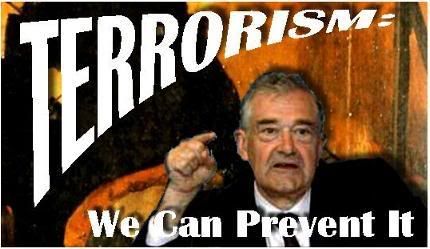
In an article in the Romanian newspaper Jurnalul National, Terry Davis, Secretary General of the Council of Europe, says that the current anti-terror tack of the Western developed nations (led by the US and UK) is, at best, imcomplete if it ignores the root causes of terrorism. In publicly saying so, he joins a growing list of world leaders and opinion makers who've made the same observation, including Philippine Chief Justice Reynato Puno, Peter Munya, the US Conference of Catholilc Bishops, John Edwards, Hugo Chavez, Fernando Lugo, Desmond Tutu, Charles Dickens, Muhammed Yunus, myself, and even Pakistan dictator Gen. Pervez Musharraf . For the record, the late Holy Father Pope John Paul II believed this too.
When will the message be acknowledged by the Bush adminstration?
In an article in the Romanian newspaper Jurnalul National, Terry Davis, Secretary General of the Council of Europe, says that the current anti-terror tack of the Western developed nations (led by the US and UK) is, at best, imcomplete if it ignores the root causes of terrorism. In publicly saying so, he joins a growing list of world leaders and opinion makers who've made the same observation, including Philippine Chief Justice Reynato Puno, Peter Munya, the US Conference of Catholilc Bishops, John Edwards, Hugo Chavez, Fernando Lugo, Desmond Tutu, Charles Dickens, Muhammed Yunus, myself, and even Pakistan dictator Gen. Pervez Musharraf . For the record, the late Holy Father Pope John Paul II believed this too.
It is crucial to fight against the recruitment, financing and incitement to terrorism through a legal framework and an international co-operation but it is equally important to deal with the conditions conducive to the spread of terrorism.
Some obvious conditions which make possible the spread of terrorism are conflicts, poverty and under-development, violations of basic human rights and no rule of law. (all emphases mine)
When will the message be acknowledged by the Bush adminstration?
Monday, April 23, 2007
IN THE DARK Post #1,001-- Philippine Chief Justice Says War on Terror in Danger of Becoming "Mindless"; Poor Suffer More From Poverty Than From Terror
An Update on the "So-called War on Terror"TM
Supreme Court Chief Justice Reynato Puno joins a long list of global public figures who stepped out of the dark and acknowledged the reality of terrorism, including Peter Munya, the US Conference of Catholilc Bishops, John Edwards, Hugo Chavez, Fernando Lugo, Desmond Tutu, Charles Dickens, Muhammed Yunus, myself, and even Pakistan dictator Gen. Pervez Musharraf who have been saying that you can't win a war on terror if you don't fight a war on poverty. For the record, the late Holy Father Pope John Paul II believed this too.
Puno criticized the "mindless" war on terrorism at the expense of civil liberties, and -- referring to the Philippines, but relevant to the US under the Bush administration -- said a state with credibility problems could not adequately protect the rights of its citizens. He said the fight against terrorism had been "more discomforting" than the terror itself.
Supreme Court Chief Justice Reynato Puno joins a long list of global public figures who stepped out of the dark and acknowledged the reality of terrorism, including Peter Munya, the US Conference of Catholilc Bishops, John Edwards, Hugo Chavez, Fernando Lugo, Desmond Tutu, Charles Dickens, Muhammed Yunus, myself, and even Pakistan dictator Gen. Pervez Musharraf who have been saying that you can't win a war on terror if you don't fight a war on poverty. For the record, the late Holy Father Pope John Paul II believed this too.
Puno criticized the "mindless" war on terrorism at the expense of civil liberties, and -- referring to the Philippines, but relevant to the US under the Bush administration -- said a state with credibility problems could not adequately protect the rights of its citizens. He said the fight against terrorism had been "more discomforting" than the terror itself.
Terrorism is terrible enough, but the mindless, knee-jerk reaction to extirpate the evil is more discomforting. One visible result of the scramble to end terrorism is to take legal shortcuts and legal shortcuts always shrink the scope of human rights. These shortcuts have scarred the landscape of rights in the Philippines.Puno said that the institutional forces of anti-terrorism engage in much flag-waving, singing of the national anthem and issuing "high-pitched" directives to military forces, the police, and citizens to use their weapons for victory at all costs. But, he said, enough is enough. Security is meaningless at the expense of individual liberty.
To put constitutional cosmetics to the military-police muscular efforts, lawmakers usually enact laws using security of the state to justify the dimunition of human rights by allowing arrests without warrants; surveillance of suspects; interception and recording of communications; seizure or freezing of bank deposits, assets and records of suspects. They also redefine terrorism as a crime against humanity and the redefinition is broadly drawn to constrict and shrink further the zone of individual rights.Puno urged political leaders -- but the appeal might be read by all of us, if we choose -- to have a broader view of terrorism, saying poverty is also a form of terrorism and the poor suffer more by their poverty than by violence.
In poor countries, it is poverty that truly terrorizes people for they are terrorized by the thought that they will die because of empty stomachs and not that they will lose their lives due to some invisible suicide bombers...The apathy of those who can make a difference is the reason why violations of human rights continue to prosper. The worst enemy of human rights is not its non-believers but the fence sitters who will not lift a finger despite their violations...Sooner or later, they will find that they who default in protecting the rights of the many will end up without rights like the many...With the incursions and threats of incursion to our human rights at this crucial moment in our history, the clarion call to each one of us is to consecrate our lives to the great cause of upholding our human rights.
Tuesday, March 20, 2007
Apocalypse Soon?
Rolling Stone put together a panel of left-wing, pinko, anti-war crazies and asked them, essentially, just exactly how bad did George W. Bush screw up the middle east in his so-called "war on terror."
The panel included such well-known radicals and communist sympathizers as:
Zbigniew Brzezinski, Gen. Tony McPeak (member of the Joint Chiefs of Staff under the first President Bush), Michael Scheuer (former CIA agent in charge of the Osama bin Laden unit), Paul Pillar (28 year veteran CIA intelligence analyst and the CIA's former lead Counterterrorist analyst), Richard Clarke (advisor to Presidents Reagan, Bush I, Clinton, and Bush II, and the National Security Council's anti-terrorism "czar" from 1992 until 2003), Juan Cole (Professor of History at the University of Michigan, a world-renowned middle-eastern scholar, and the creator of the influential blog Informed Consent), Chas Freeman (US Ambassador to Saudi Arabia during the first Gulf War and the president of the Middle East Policy Council), and Nir Rosen (fellow of the New America Foundation), and Bob Graham (former Governor of Florida, 1978-1987, Former US Senator, 1987-2005, former Chair of the Senate Select Committee on Intelligence).
The Rolling Stone article is essential reading, if sobering -- even frightening. I excerpt a few of the panel's thoughts:
The Best-Case Scenario:
The panel included such well-known radicals and communist sympathizers as:
Zbigniew Brzezinski, Gen. Tony McPeak (member of the Joint Chiefs of Staff under the first President Bush), Michael Scheuer (former CIA agent in charge of the Osama bin Laden unit), Paul Pillar (28 year veteran CIA intelligence analyst and the CIA's former lead Counterterrorist analyst), Richard Clarke (advisor to Presidents Reagan, Bush I, Clinton, and Bush II, and the National Security Council's anti-terrorism "czar" from 1992 until 2003), Juan Cole (Professor of History at the University of Michigan, a world-renowned middle-eastern scholar, and the creator of the influential blog Informed Consent), Chas Freeman (US Ambassador to Saudi Arabia during the first Gulf War and the president of the Middle East Policy Council), and Nir Rosen (fellow of the New America Foundation), and Bob Graham (former Governor of Florida, 1978-1987, Former US Senator, 1987-2005, former Chair of the Senate Select Committee on Intelligence).
The Rolling Stone article is essential reading, if sobering -- even frightening. I excerpt a few of the panel's thoughts:
The Best-Case Scenario:
Richard Clarke: All the things they say will happen are already happening. Iraq is already a base for terrorists; there is already a civil war. We've got 150,000 troops there now and we can't stop it.The Most Likely Outcome:
McPeak: You have to hope that Iraq devolves into a federal state with three strong regional governments. But that has its downsides: The Turks would go berserk. They would see Kurdistan as a base for the Kurdish insurgency inside Turkey, which has bedeviled them like the IRA in Ireland or the Basques in Spain...
Scheuer: The neoconservatives and their war in Iraq have made Israeli security worse than at any time since 1967. You'll see more and more people trying to launch attacks in Israel who are not Palestinian or Lebanese. None of it bodes well for a Middle East peace settlement.
McPeak: We're going to see a full-scale intercommunal war that may not burn out until one side is all dead, all gone. The Kurds would like to sit on the sidelines, but I don't see how they stay out, especially up in the Kirkuk area, where they sit on a lot of oil. This is going to be ethnic cleansing like we had in Kosovo or Bosnia -- but written big, in capital letters. And we can't stop it.The Worst-Case Scenario:
Chas Freeman: The most efficient way to avoid mass killings is to help the Shiites win fast, consolidate their damn dictatorship and get the hell out. The level of anarchy and hatred and emotional disturbance is such that it's very hard to imagine anything except a Saddam-style reign of terror succeeding in pacifying the place.
Rosen: Our Sunni allies in the region, the so-called moderate states -- dictatorships like Jordan and Saudi Arabia -- are pushing the U.S. to switch sides and support the Sunnis. We've been working up to that, obviously. The whole buildup to a new war against Iran, which sounds so much like the buildup in 2002, is part of that. You no longer hear about Al Qaeda in Iraq. More and more we're hearing about Iran and Shias.
Graham: This administration seems to be getting ready to make -- at a much more significant, escalated level -- the same mistake we made in Iran that we made in Iraq. If Iraq has been a disaster, this would be multiple times Iraq. The extent to which this could be the horror of the twenty-first century is hard to exaggerate.
Brzezinski: If the war continues without any American willingness to accommodate regionally and to pull out, the Iraq War will be extended to Iran. And if we get involved in a war with Iran, that raises the prospect of a twenty-year-long involvement in protracted violence in Iraq, Iran, Afghanistan and probably Pakistan. I'm not a prophet, but if the president doesn't change course, then the more grim prognosis is a likely one.
Rosen: Iraq will be the battleground where the Sunni-Shia conflict will be fought, but it won't be limited to Iraq. It will spread. Pandora's box is open. We didn't just open it, we opened it and threw fuel into it and threw matches into it. You'll soon see Sunni militias destabilizing countries like Jordan and Syria -- where the Sunni Muslim Brotherhood is very strong...McPeak ends with an "attaboy" for those who weren't paying attention to reality and voted for George W. Bush in 2004:
Scheuer: I can't help but think we've signed Jordan's death warrant. The country is already on a simmering boil because of the king's oppression of Islamists. It could turn into a police state like Egypt, or an incoherent, revolving-door-type government like Lebanon is becoming now.
McPeak: The worst case? Iraq's Sunnis begin to be backed into a corner, then the Sunni governments -- Jordan, Saudi Arabia -- jump in. Israel sees that it's threatened by these developments. Once the Israelis get involved, then everybody piles on. And you've got nuclear events going off in the Middle East. That would be about as bad as it could get.
Cole: During the war between Iraq and Iran, Saddam and Khomeini didn't destroy each other's oil-producing capabilities, because they knew it would make each of them a Fourth World country. But if you get a big multicountry guerrilla war, guerrillas could do what they've been doing in northern Iraq: Hit the oil pipelines. Guerrillas aren't calculating it the way states are as far as mutually assured destruction. If you got pipeline sabotage in Iran and Saudi Arabia and southern Iraq, you could take twelve percent of the world's petroleum production off the market. That looks like the second Great Depression.
McPeak: This is a dark chapter in our history. Whatever else happens, our country's international standing has been frittered away by people who don't have the foggiest understanding of how the hell the world works. America has been conducting an experiment for the past six years, trying to validate the proposition that it really doesn't make any difference who you elect president. Now we know the result of that experiment [laughs]. If a guy is stupid, it makes a big difference.How in the world did we let this happen?
Subscribe to:
Posts (Atom)