Wednesday, January 16, 2008
A Dirty Trick by the Ron Paul Campaign?
Wednesday, May 16, 2007
Fight Against Terrorism by Fighting Poverty

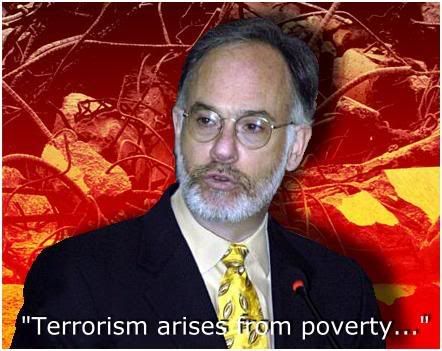
Recently, Terry Davis, Secretary General of the Council of Europe, wrote an article in the Romanian newspaper Jurnalul National cautioning that the current anti-terror tack of the Western developed nations (led by the US and UK) is, at best, imcomplete if it ignores the root causes of terrorism. Now, US Ambassador to Turkey Ross L. Wilson has said the same thing, joining a growing chorus of world leaders and opinion makers, including Philippine Chief Justice Reynato Puno, Peter Munya, the US Conference of Catholilc Bishops, John Edwards, Hugo Chavez, Fernando Lugo, Desmond Tutu, Charles Dickens, Muhammed Yunus, myself, and even Pakistan dictator Gen. Pervez Musharraf . For the record, the late Holy Father Pope John Paul II believed this too. That sounds like a pretty good bunch of people to stack up against the likes of Feith, Wolfowitz, Cheney, Rumsfeld, Kristol, and the rest of the PNAC cabal that persists in Washington. I'll take John Paul II over George W. Bush any day.
Wilson told a conference conducted by the George C. Marshall European Center for Security Studies and the Center of Excellence-Defense Against Terrorism in cooperation with the NATO-Russia Council that
Most people would find it hard to argue against the idea that terrorist violence arises, sociologically speaking, out of poverty, despair, hopelessness and resentment.It's amazing how many people don't find it all hard to argue this point. To some, terrorism has nothing to do with poverty, it has to do with an evil ideology that seeks nothing but political hegemony. This thinking links up comfortably with the Bush administration's "good vs evil" approach to foreign policy. Besides, they often point out, so many of these terrorists went to school and had jobs...
It is true that terrorist leaders seem more often than not to come from middle-class backgrounds. But terrorists do not just spring forth from Medusa's head, and effective government policy will seldom just involve cutting off terrorism's tentacles. The causes must be considered, and constructive policies must be devised to draw people away from the dead ends of violence and despair.Yes. Are you listening?
Wednesday, April 25, 2007
Council of Europe Chief : Prevent Conditions That Create Terrorism

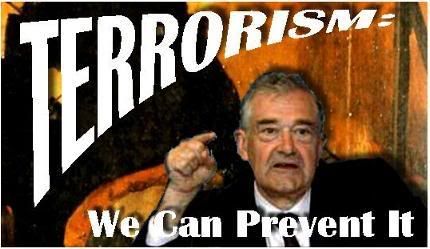
In an article in the Romanian newspaper Jurnalul National, Terry Davis, Secretary General of the Council of Europe, says that the current anti-terror tack of the Western developed nations (led by the US and UK) is, at best, imcomplete if it ignores the root causes of terrorism. In publicly saying so, he joins a growing list of world leaders and opinion makers who've made the same observation, including Philippine Chief Justice Reynato Puno, Peter Munya, the US Conference of Catholilc Bishops, John Edwards, Hugo Chavez, Fernando Lugo, Desmond Tutu, Charles Dickens, Muhammed Yunus, myself, and even Pakistan dictator Gen. Pervez Musharraf . For the record, the late Holy Father Pope John Paul II believed this too.
It is crucial to fight against the recruitment, financing and incitement to terrorism through a legal framework and an international co-operation but it is equally important to deal with the conditions conducive to the spread of terrorism.
Some obvious conditions which make possible the spread of terrorism are conflicts, poverty and under-development, violations of basic human rights and no rule of law. (all emphases mine)
When will the message be acknowledged by the Bush adminstration?
Monday, April 23, 2007
IN THE DARK Post #1,001-- Philippine Chief Justice Says War on Terror in Danger of Becoming "Mindless"; Poor Suffer More From Poverty Than From Terror

Supreme Court Chief Justice Reynato Puno joins a long list of global public figures who stepped out of the dark and acknowledged the reality of terrorism, including Peter Munya, the US Conference of Catholilc Bishops, John Edwards, Hugo Chavez, Fernando Lugo, Desmond Tutu, Charles Dickens, Muhammed Yunus, myself, and even Pakistan dictator Gen. Pervez Musharraf who have been saying that you can't win a war on terror if you don't fight a war on poverty. For the record, the late Holy Father Pope John Paul II believed this too.
Puno criticized the "mindless" war on terrorism at the expense of civil liberties, and -- referring to the Philippines, but relevant to the US under the Bush administration -- said a state with credibility problems could not adequately protect the rights of its citizens. He said the fight against terrorism had been "more discomforting" than the terror itself.
Terrorism is terrible enough, but the mindless, knee-jerk reaction to extirpate the evil is more discomforting. One visible result of the scramble to end terrorism is to take legal shortcuts and legal shortcuts always shrink the scope of human rights. These shortcuts have scarred the landscape of rights in the Philippines.Puno said that the institutional forces of anti-terrorism engage in much flag-waving, singing of the national anthem and issuing "high-pitched" directives to military forces, the police, and citizens to use their weapons for victory at all costs. But, he said, enough is enough. Security is meaningless at the expense of individual liberty.
To put constitutional cosmetics to the military-police muscular efforts, lawmakers usually enact laws using security of the state to justify the dimunition of human rights by allowing arrests without warrants; surveillance of suspects; interception and recording of communications; seizure or freezing of bank deposits, assets and records of suspects. They also redefine terrorism as a crime against humanity and the redefinition is broadly drawn to constrict and shrink further the zone of individual rights.Puno urged political leaders -- but the appeal might be read by all of us, if we choose -- to have a broader view of terrorism, saying poverty is also a form of terrorism and the poor suffer more by their poverty than by violence.
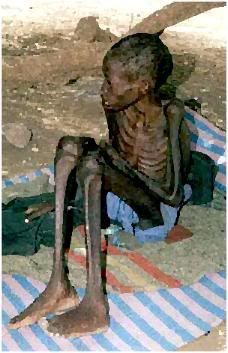
In poor countries, it is poverty that truly terrorizes people for they are terrorized by the thought that they will die because of empty stomachs and not that they will lose their lives due to some invisible suicide bombers...The apathy of those who can make a difference is the reason why violations of human rights continue to prosper. The worst enemy of human rights is not its non-believers but the fence sitters who will not lift a finger despite their violations...Sooner or later, they will find that they who default in protecting the rights of the many will end up without rights like the many...With the incursions and threats of incursion to our human rights at this crucial moment in our history, the clarion call to each one of us is to consecrate our lives to the great cause of upholding our human rights.
Wednesday, April 04, 2007
Kiwi Green Party : War on Poverty as Urgent as War on Terror
Now the New Zealand Green Party Foreign Affairs Spokesperson Keith Locke has said the same thing. And he's right. And he's taking his government to task.
This era of global apathy and global greed has to end. This era of global, un-regulated, laissez faire, "free-market" capitalism has to end. Rational regulation was just as much a part of Adam Smith's vision as irrational speculation.Whenever the Government supports laws to combat global terrorism, it routinely invokes UN guidelines on the subject as a rationale, even when that sometimes means restricting the civil liberties of New Zealanders. Yet when it comes to UN initiatives aimed at combating global poverty, the Government has been willing to drag its feet.
In years past, the Prime Minister Helen Clark has acknowledged the links that exist between terrorism and its breeding grounds in poverty, inequality, disease and lack of opportunity. The Government should be treating global poverty with the same urgency it currently affords to global terrorism.
Democracy, NOT plutocracy.