Showing posts with label so-called war on terror. Show all posts

Tuesday, December 30, 2008

The Bush Legacy -- a Reality Check

The "legacy" of the Bush presidency is one of failure -- failed policies, failed worldview, failure to uphold the Constitution, failure to respect the will of the people -- utter failure.

This legacy includes:

On the plus side, perhaps we'll see, as a result of Bush's disastrous presidency, an attenuation of

This is just scratching the surface. We're only up to May of 2005. More to follow as the Bush presidency dwindles.

Wednesday, November 05, 2008

A Proud, Proud Day for the United States of America


I started this blog four years ago today.

I started it out of frustration with the sordid relationship between our political system and our mass media. As the title of this blog ought to suggest, I thought that our systems of mass communication were leaving most Americans IN THE DARK.

While that situation has clearly not entirely been rectified, and I remain terribly concerned about the ignorance that emperils us (just yesterday before voting, I spoke with a woman who told me she voted for the guy "with the Vice President from Canada" -- I wish I were making this up), I am heartened by what I've seen this past few years. And last night, as I watched the election returns, and cheered with my wife as the polls on the west coast closed and Senator Barack Obama became President-elect Barack Obama, and we listened, teary-eyed, to his victory speech, I felt prouder to be an American than I have in many, many years.

When I started this blog, I believed that the United States of America was living in the darkest hour of my lifetime. US Intelligence agencies were being politicized. Hundreds of thousands were dying in Iraq (and still are). The Iraqi insurgency was just finding its legs. Domestic surveillance of private individuals was just beginning. And -- even before Abu Ghraib -- observers were criticizing US interrogation techniques as "torture."

And the mass media largely ignored or downplayed everything, or aided and abetted the Bush administration's conceptual construction of a "post-9/11 world." It was the perfect prescription for fascism.

I won't dwell long on what the election of Barack Obama means to me personally. As the son of Irish immigrants to the United States in the first half of the twentieth century, let me just say that I am happy for him. As a university professor in an urban setting in a large American city, I feel my students' joy and I celebrate with them, knowing that many of their parents can hardly believe this day has actually come. But as an American, I am extremely proud today, not just because we have turned our backs on centuries of hatred and elected an African-American President, but also because we have managed to see beyond the fear, resentment, greed and hatred that have characterized the last eight years, and rejected the policies they spawned. This is what I am truly proud of.

The dawn is breaking. I think I see the light. It's morning in America.

Monday, September 15, 2008

An E-Mail Exchange With Howie, My (Far) Right-Wing Friend in NY: Is There, or Is There Not, a "Bush Doctrine?"

Howie: Basically, the term "Bush Doctrine" was coined by Charles Krauthammer, and I sent you his article that "suggested that the Bush administration policies of unilaterally withdrawing from the ABM treaty and rejecting the Kyoto protocol, together with others, amounted to a radical change in foreign policy that should be called the Bush doctrine."

Me: Howie, you're killing me with this. There are so many more important things I ought to be doing with my time than trying to persuade you that a pit-bull is not a pig and that a horse is not a house and that fantasy is not reality. It is, I believe, a powerful testimony of my unfailing love for you that I go to all this trouble. I only wish you had any respect for me -- and for yourself -- and took the world more seriously.

I did a Lexis-Nexis search (it is a subscription database of, among other things, US and world newspapers, newsmagazines, and radio and television news transcripts which I have access to through Roosevelt's library) of the phrase "Bush Doctrine" for all the time between June 2002 and August 15, 2008. In other words, it does NOT search anything AFTER the Palin interview. I got over 1000 results. Please read them carefully. Here's my disclaimer, though: I'm only copying the essential parts of each story, where the term "Bush Doctrine" is used specifically. And, since this is a subscription service, I can't give you any hyperlinks. I urge you to go to a library and get a copy of each if you want to read the whole article.

Here's the very first one, from the Sydney (Australia) Morning Herald:

  • Kill first, ask questions later

BYLINE: Robert Manne. Robert Manne is associate professor of politics at La Trobe University.
SECTION: NEWS AND FEATURES; Opinion; Pg. 13 LENGTH: 966 words
September 30, 2002
Monday Late Edition

The black holes in Bush's logic might suck us all in.TEN days ago,
George Bush handed to the Congress a document of fundamental importance, outlining a new military doctrine for the United States.

The new doctrine argues that in the 10 years following the Soviet collapse, the US failed to grasp the nature of the threats posed by the post-Cold War world. With the terrible events of September 11, America awoke.

At first, the US characterised the new enemy it faced as "terrorism". Later, it refined the idea of the new enemy to "terrorism with a global range", a euphemism for the
kind of terrorism with the capacity to inflict harm on the civilian populations in America or the West.

Since the shock of September 11, the new enemy has expanded to include what have been called "rogue states". In the
Bush doctrine, a rogue state is a regime which brutalises its own people, seeks to acquire weapons of mass destruction and expresses hatred for the US...We arrive here at the heart of the new Bush military doctrine. The US, it is claimed, presently faces the prospect of
attack either from one of the rogue states or from a terrorist group supplied by
them with weapons of mass destruction. Before this kind of threat, Cold War
ideas about deterrence and containment are obsolete. The only rational military strategy is the "pre-emptive strike".

Here's one from the Straits Times (Singapore) from October of 2002 (first two paragraphs):

  • Dubya's dangerous and divisive doctrine

October 16, 2002 Wednesday
AMITAV ACHARYA

THE new American strategic doctrine of pre-emptive strikes, enunciated a year after Sept 11, provokes more discord internationally than it catalyses accord domestically.

Past presidential doctrines helped American leaders mobilise domestic support and organise international coalitions. The Bush Doctrine is the most divisive post-war pronouncement.

From the Washington Post, October 2003 (I'm copying the entire article, as it directly references the Bush Doctrine several times, and even quotes Richard Perle -- one of the neo-cons who created it through his work at PNAC -- directly referring to the Bush Doctrine as preemptive first strike):

  • The 'Bush Doctrine' Experiences Shining Moments

December 21, 2003 Sunday Final Edition

BYLINE: Dana Milbank, Washington Post Staff Writer

SECTION: A Section; A26LENGTH: 1041 words

It has been a week of sweet vindication for those who promulgated what they call the Bush Doctrine.

Beginning with the capture of Saddam Hussein a week ago and ending Friday with an agreement by Libya's Moammar Gaddafi to surrender his unconventional weapons, one after another international problem has eased.

On Tuesday, the leaders of France and Germany set aside their long-standing opposition to the war in Iraq and agreed to forgive an unspecified amount of that country's debt. On Thursday, Iran signed an agreement allowing surprise inspections of its nuclear facilities after European governments applied intense pressure on the U.S. foe. On Friday, Libya agreed to disarm under the watch of international inspectors, just as administration officials were learning that Syria had seized $23.5
million believed to be for al Qaeda.

To foreign policy hard-liners inside and outside the administration, the gestures by Libya, Iran and Syria, and the softening by France and Germany, all have the same cause: a show of American might.

Those who developed the Bush Doctrine -- a policy of taking preemptive, unprovoked action against emerging threats -- predicted that an impressive U.S. victory in Iraq would intimidate allies and foes alike, making them yield to U.S. interests in other areas.

Though that notion floundered with the occupation in Iraq, the capture of Hussein may have served as the decisive blow needed to make others respect U.S. wishes, they say. "It's always been at the heart of the Bush Doctrine that a more robust policy would permit us to elicit greater cooperation from adversaries than we'd had in the past when we acquiesced," said Richard Perle, an influential adviser to the
administration. "With the capture of Saddam, the sense that momentum may be with us is very important."

Perle had provoked much criticism for saying a successful U.S. invasion of Iraq would signal to other foes that "you're next." But he said the actions by Libya and Iran prove that the threat alone was sufficient to produce action. "Gaddafi surely had to take more seriously that we would not allow him to get away with the programs he was embarked," he said.

Perle and the other "neo-conservative" hawks whose views dominate the Bush administration know better than to claim victory. Gaddafi or the Iranians may still cheat despite admitting inspectors. And other potential foes, notably North Korea and China, have shown little susceptibility to the threat implicit in the Bush Doctrine.

Still, Perle allowed, "it's nice to have a good week every once in a while."

Bush's domestic adversaries have had some trouble responding to the administration's diplomatic successes. Sen. John F. Kerry (D-Mass.), a presidential aspirant, portrayed the success with Libya as an exception to the Bush Doctrine. "Ironically, this significant advance represents a complete U-turn in the Bush administration's overall foreign policy," he said in a statement Saturday. "An administration that scorns multilateralism and boasts about a rigid doctrine of military preemption has almost in spite of itself demonstrated the enormous potential for improving our national security through diplomacy."

But Bush's supporters say it is precisely his willingness to go it alone and take preemptive action that has encouraged other countries to seek diplomatic solutions before the United States launches a military attack. The Libya and Iran concessions "show the peripheral benefit of preemption," said Kenneth Adelman, a Reagan administration arms control official who now serves on a Pentagon advisory panel. "Most of all it scares the bejesus out of rogue dictators." As for stubborn allies such as Jacques Chirac and Gerhard Schroeder, "they pay more attention when there's a forceful U.S. policy," Adelman said.

It is unlikely, of course, that France or Germany would acknowledge that they are reacting to U.S. strength. Yet it is noteworthy that they were conciliatory on the issue of Iraqi debt forgiveness after Hussein was captured -- even though they were complaining bitterly just a week before about a Bush plan to exclude them from U.S.-funded Iraq reconstruction projects.

And it is inarguable that Germany and France have taken a more active role in winning Iranian compliance with weapons inspections since the United States invaded Iraq. The foreign ministers of Germany, France and Britain visited Iran in
October, overcoming Iran's longtime resistance to signing a monitoring agreement.
"The Europeans never would have taken these steps [in Iran] without Bush taking the steps he took in Iraq," said Gary Schmitt, who directs the hard-line Project for the New American Century. "The Europeans don't want us to do another Iraq there, so they're rushing in to get a deal. Bush gets an immense amount of credit for laying out what the agenda is and making others step up to the plate."

Bush still has some inconsistencies to work out with his doctrine. Earlier this month, he drew rebukes from conservatives for undermining democratic Taiwan to win favor with totalitarian China. And, as Bush's domestic opponents point out, he has been contradictory in his views of international organizations. Rep. Edward J. Markey (D-Mass.) said the administration's support for International Atomic Energy Agency inspectors in Libya and Iran "is difficult to reconcile with the administration's previous ridicule of IAEA inspectors in Iraq."

But such complaints, at least for now, have been overshadowed by the results achieved with Iran and Libya. That was the clear message Bush delivered in his unusual appearance late Friday in the White House briefing room. Mentioning the fate of Hussein, Bush said, "These actions by the United States and our allies have sent an unmistakable message to regimes that seek or possess weapons of mass destruction."

If Bush was oblique, a senior aide who briefed reporters after the president's statement, was quicker to take credit. "The outcome today is a response [to] the policies that we have pursued," he said. The official said the secret discussions with Libya began in March -- when the invasion of Iraq started. "I can't imagine that Iraq went unnoticed by the Libyan leadership," the aide said.

And -- WOW!!! -- I actually found a reference to the phrase "Bush Doctrine" that links it directly to the White House and the Bush administration, and dates it as far back as October 2001.

  • 'Bush Doctrine' sets up rules of engagement

USA TODAY
October 9, 2001, Tuesday, FIRST EDITION
BYLINE: Laurence McQuillanSECTION: NEWS; Pg. 8A LENGTH: 526 words DATELINE: WASHINGTON

WASHINGTON -- White House officials gave a name Monday to the rules of engagement driving the U.S. war on terrorism -- the "Bush Doctrine." The policy makes any nation or group that tolerates terrorists a potential target.

From the Toronto (Canada) Globe and Mail:

  • Monroe, Truman and Bush?; U.S. leader aims to become only the third; chief to lay a foreign-policy cornerstone

The Globe and Mail (Canada)
October 20, 2001 Saturday
BYLINE: JOHN IBBITSON SECTION: INTERNATIONAL NEWS; The War on Terror: THE BATTLE OF IDEAS; Pg. A10 LENGTH: 751 words

DATELINE: WASHINGTON

There was the Monroe Doctrine. There was the Truman Doctrine. Now, there is the Bush Doctrine.

In his Sept. 20 speech to Congress, U.S. President George W. Bush declared that all nations must either join the United States in combatting terrorism, or be its enemy. He said the government would act against any individual, organization or state "of global reach" that supports terrorism.

In the weeks since, Mr. Bush has referred to "the doctrine I spelled out to the American people." Vice-President Dick Cheney invoked "the Bush Doctrine" in a rousing call to arms Thursday evening.

Coalition forces are attacking Afghanistan in the air and now on the ground in the name of the Bush Doctrine. A growing chorus of politicians demands that the United States attack Iraq in the name of the Bush Doctrine.

From the Boston Globe and the Australian Financial Review on the global political implications of the Bush Doctrine, from October and December of 2001, respectively:

  • A DOUBLE STANDARD IN WAR ON TERRORISM?

The Boston Globe
October 24, 2001, Wednesday ,THIRD EDITION
BYLINE: By Scot Lehigh, Globe Staff SECTION: OP-ED; Pg. D7 LENGTH: 699 words

IF YOU WISH to converse with me, Voltaire said, define your terms.

In speaking to the world, President Bush needs to do just that, for his zero-tolerance antiterrorism doctrine is one that both friends and rivals clearly hope to appropriate for their own purposes.

Consider our newfound comrade Vladimir Putin, the Russian president. Noting that the Kremlin considers the Chechen separatists to be terrorists with ties to Osama bin Laden, he has declared that the United States and Russia share a common foe.

Or Prime Minister Ariel Sharon of Israel, who called Palestinian leader Yasser Arafat Israel's Osama bin Laden. Why, with America drawing a line in the sand against terrorism, should Israel be pressured to negotiate with a man who has sponsored and encouraged terrorists, he asked?

A bit less vocal was India, which faces attacks by Islamic militants hoping to pry all of disputed Kashmir away. "If the US can strike Afghanistan after the Sept. 11 attacks ... why can't we take similar action against terrorists harbored by Pakistan?" wondered Farooq Abdullah, Kashmir's chief minister. Orwellian China would just as clearly like the world to view Tibet through the lens of the Bush doctrine, while Malaysia has used it to justify a suppression of peaceful dissent. And that's just for starters.

  • Bush Doctrine suddenly crystallises

The Australian Financial Review
December 10, 2001 Monday
BYLINE: Peter Hartcher SECTION: Pg. 1/11. LENGTH: 99 words

The US President, George W Bush, has won huge support for his stand against terrorism. Bush has established a doctrine that holds all countries that harbourterrorists as being accountable to the US. Bush has declared that for every country that support terrorists there will be a "day of reckoning". Governments around the world have received a warning from what has happened in Afghanistan.

The war in Afghanistan having almost reached a conclusion, the US Government must decide in which country its forces will seek terrorists next. An attack on Saddam Hussein's regime in Iraq appears imminent.

Howie (and all my other right wing friends out there), I know you. I don't expect any of this to change your (for lack of a better word) "mind." But you are wrong about this, you are being deceived by post-game spin, and nothing you say or do or believe can EVER change history. There is a Bush Doctrine, it was promulgated by the White House, it has been debated and discussed in terms of its implications for foreign policy and for global politics, and neither Sarah Palin nor you seems ever to have heard of it.

The GOP and right-wing spinmeisters might indeed be successful persuading those American people who choose ignorance over information, and who choose to be led around on a leash by the right-wing media that there are "several Bush Doctrines," but history has already recognized one.

And that's really all there is to it. A century from now people will be studying the Bush Doctrine, and what they'll be studying is this dangerous principle of the preemptive first strike.

There's nothing you can do to change that.

Thursday, September 04, 2008

Republican National Convention, Night Four

Update #1, 8:10 pm (CDT): Lindsay Graham is a creepy, lying twit. More to follow.
Update #2, 7:00 am (CDT) 9/5/08:

I am profoundly ambivalent about this post, and this is one of the reasons why I waited until this morning to sit down and write. I needed to let last night's speech roll around in my head and try to figure out what, exactly, it meant to me. I don't think the Republicans sitting in the convention hall in St. Paul had this reaction; indeed, that is one of the defining differences between Democrats and Rpublicans.

There is this kind of knee-jerk, "America first," my-country-right-or-wrong thing that many Americans have grown up calling "patriotism" that isn't necessarily patriotism at all. The Republican Party is filled with people these days who have exactly this definition of patriotism. But that's not necessarily what patriotism actually is. In fact, the type of love-it-or-leave-it, USA!USA!USA!-chanting patriotism that we've experienced since the Reagan years is what is ultimately behind the crippling partisanism we're suffering through right now. Country, rather than principle, can become an ideology, and when that happens, bad things usually follow. As David Hume said, "The heights of popularity and patriotism are still the beaten road to power and tyranny; flattery to treachery; standing armies to arbitrary government; and the glory of God to the temporal interest of the clergy." That's what Democrats are against. That's what I'm against, and I'm going to keep talking about it, beacuse as Barbara Ehrenreich has told us, "No matter that patriotism is too often the refuge of scoundrels. Dissent, rebellion, and all-around hell-raising remain the true duty of patriots."

So let me raise some hell.

John McCain is an upstanding guy and a true patriot. I remember when he returned with other POWs at the end of the Vietnam war. I remember -- even though I had shifted from staunchly pro-war to vehemently anti-war between 1968 and 1972 -- being in awe of his courage and strength having endured imprisonment, isolation, and torture for so long. It's not something I think I could have endured myself without breaking, dying, or losing my mind.

But John McCain is not the right man for this job, not now. I would have been quite satisfied (though not happy) if he had won the GOP nomination in 2000 and beat Al Gore in the general election to become President. Because unlike George W. Bush (whose disgusting campaign, engineered by talking pig Karl Rove, smeared and abused McCain and his family), John McCain is a decent man.

So last night, whenever he talked about his experiences as a POW, I was moved and silent. I will never lose my respect or my gratitude for John McCain for enduring what he did in Vietnam.

But when he talked about the things he really stands for, I found myself yelling at the television, "NO! He can't be our next president."

These are tough times for many of you. You’re worried about keeping your job or finding a new one, and are struggling to put food on the table and stay in your home. All you ever asked of government is to stand on your side, not in your way. And that’s just what I intend to do: stand on your side and fight for your future.

Except that this is not true. That is exactly not what John McCain intends to do. It has become very clear that John McCain -- either cynically, or through mis-placed faith -- intends to maintain the same neo-liberal economic policies that have so many people worried about keeping their jobs, finding a new one, and struggling to put food on their tables and stay in their homes.

McCain is still a dyed-in-the-wool supply-sider who believes in lower taxes (this is NOT as great as it sounds, since -- as we've seen in the last eight years -- the middle class don't really benefit much from a $200 break in their taxes, but the wealthy do; and all the while the government has less revenue to serve its citizens), incentives for investment (big investors are STILL making money while most Americans are sucking wind), the removal of "barriers" to trade, and "free and open" (i.e., unregulated) markets -- which will mean even more jobs being moved overseas.

Let's be honest: for all they tried to hide it this week, this is still the Republilcan Party. And John McCain may be running as "the Anti-Bush," but he's still a Republican. And these are, since the Reagan years, core Republican values. Not the welfare of the Aerican people, but the welfare of American business.


I fought for the right strategy and more troops in Iraq, when it wasn’t a popular thing to do. And when the pundits said my campaign was finished, I said I’d rather lose an election than see my country lose a war.


Thanks to the leadership of a brilliant general, David Petraeus, and the brave men and women he has the honor to command, that strategy succeeded and rescued us from a defeat that would have demoralized our military, risked a wider war and
threatened the security of all Americans.


The 800 pound elephant in the room, the man behind the curtain, the dirty secret behind this example of pretty-dog-gone-effective propaganda is that "the surge" has not worked. It is not working as we speak. And as we will find out on October 1, it will never work. When will we, in our culture-centric, teflon-coated, chrome-plated, fossil fuel-consuming bubbles admit to ourseves that Iraq is not America, Iraqis are not Americans (or even Europeans), western techniques does not equal eastern technique, our values are not their values?

Let me tell you why the surge isn't working.

At about the same time that John McCain (and Joe Lieberman) was supporting George W. Bush's request to send an additional 5 brigades to Iraq, the US military was negotiating with Sunni fighters (who made up the bulk of the insurgency) to stop fighting with us. Many of the Sunni fighters belonged to what are called "Awakening Councils, " regional quasi-political/religious groups who feared and resented the US-backed creation of a Shiite government. The US military managed to negotiate a semi-official status for the Sunni Awakening groups with the Shiite-led Iraqi Government.

Regional Awakening Groups now police local areas and each member gets paid a monthly stipend by the US Government of about $30 per month -- and in Iraq right now, that's a lot of money. So there has been, during the same time the "surge" has been in place, both a pragmatic compromise giving political legitimacy to groups that are, for all intents and purposes, sectarian militias, and a financial incentive not to kill Americans to the 100,000 (and growing) members of the Awakening groups.

But that will all end on October 1, when direct responsibility for, and authority over, the Sunni Awakening Councils will pass from US hands to the Shiite-controlled Iraqi government. There will be an almost immediate upturn in violence, because the Shiites never saw recognition of the Awakening groups as anything more than a stop-gap measure in helping the US military appear to be gaining control so that a timetable for withdrawal could be set. Their semi-official status will disappear, as will their stipends, and they will return to attacking Shiites and US troops.

The docile US mass media will report it as the US Government describes it -- not as a failure of the surge, but as some "new" problem between "extremists" or "terrorists" and the "legitimate government of Iraq." But make no mistake about it -- the regional, tribal, and sectarian hatred that was unleashed the moment we invaded Iraq and deposed Saddam Hussein never went away as a result of this "surge," and has not abated as a result of it.

I fight to restore the pride and principles of our party. We were elected to change Washington, and we let Washington change us. We lost the trust of the American people when some Republicans gave in to the temptations of corruption. We lost their trust when rather than reform government, both parties made it bigger. We lost their trust when instead of freeing ourselves from a dangerous dependence on foreign oil, both parties and Senator Obama passed another corporate welfare bill for oil companies. We lost their trust, when we valued our power over our principles.

(~~channeling Ronald Reagan~~) Well, there you go again!

It's not exactly the way you explain it, Sen. McCain. The Republican Party lost the trust of the American people when Republicans gave into the temptation of corruption, to be sure. But the Republicans also lost the trust of the American people when they lied about a war, mishandled its conduct, began torturing prisoners, ignored the Geneva Conventions, denied prisoners due process of law, abandoned habeus corpus, and weakened our Constitutional human rights.

It is the GOP in the last eight years, not the Democratic Party, that has increased the size of government, and the level of government spending, and the size of the national debt, and our indebtedness to nations like China.

Obama and the Democratic Party have been in the forefront of the fight to fund research into alternative energy sources. Obama voted for the legislation McCain referred to because, in fact, it included a promise of funding for alternative energies. Obama attached an amendment to this bill calling for the stripping of the tax breaks for the oil and gas companies, but the amendment was defeated. In the end, Obama voted for the bill because of the promise of funding for research into new sources of energy.


Education is the civil rights issue of this century. Equal access to public education has been gained. But what is the value of access to a failing school? We need to shake up failed school bureaucracies with competition, empower parents with choice, remove barriers to qualified instructors, attract and reward good teachers, and help bad teachers find another line of work.


When a public school fails to meet its obligations to students, parents deserve a choice in the education of their children. And I intend to give it to them. Some may choose a better public school. Some may choose a private one. Many will choose a charter school. But they will have that choice and their children will have that opportunity.


Wow. "Education is the civil rights issue of this century." Is that ever a carefully coded sentence. Equal access to public education has been gained, but not equal access to equal resources. Segregation caused by racist, red-lining marketing practices in the real estate industry, to say nothing of the lingering racism that remains in American society, yields poverty-stricken neighborhoods and areas without a sufficient tax base to fund quality schools with good teachers, books, and equipment.

No, Senator McCain, civil rights is the civil rights issue of the 21st century, as it was of the 20th. Stop blaming teachers. Teachers -- especially teachers in the poorest areas in America -- rank alongside POWs in my esteem as America's greatest patriots. Oh, yeah -- and librarians too, Governor Palin. Stop using teachers as a scape goat for underfunded schools and for families that think you can use television as a babysitter for the first six years of their lives and they'll still be prepared for a literate education.

And stop holding out symbolic tokens to families who don't want their children to go to school with black and hispanic children. Stop trying to entice parents who don't want their children to learn about science in science class. I don't want my tax dollars going to schools of this type, or to home schooling moms who teach their children that Jesus is a Republican and President Bush was sent by God to lead us after 9/11. Believe what you want, teach your children what you want, but don't ask me to subsidize your kids' religious educations.

We have dealt a serious blow to al Qaeda in recent years. But they are not defeated, and they’ll strike us again if they can.

To me, this was one of the most egregious, misleading pieces of innuendo of McCain's entire speech. We have not"dealt a serious blow" to al Qa'ida. Al Qa'ida is not a nation, not an army. It has no command structure, no political structure. It can't be "dealt a serious blow" through military means, it can only be made stronger, because al Qa'ida is an idea.

Far from "dealing a serious blow" to al Qa'ida, we have helped them and made them stronger. The 2007 National Intelligence Estimate, "The Terrorist Threat to the US Homeland" confirms this, and I don't understand how McCain can make this amazingly deceitful claim. The report describes how the Iraq war has increased the strength, numbers, and support of al Qa'ida outside the developed world.

The answer to the problem of terrorism in the 21st will not be a military response, any more than it was the answer in the 20th century in Ireland, in Germany, in Italy, in Basque Spain. John McCain, noble and heroic veteran of the Vietnam war doesn't get it. I wish heroes read histories.

I appreciated McCain's exhortation, at the end of his speech, to stand up and fight for America. It was one of the best pieces of hortatory rhetoric I've heard since Henry V (Shakespeare's play -- I don't actually remember Henry V personally):

Once more unto the breach, dear friends, once more,
Or close the wall up with our English dead!
In peace there's nothing so becomes a man
As modest stillness and humility,
But when the blast of war blows in our ears,
Then imitate the action of the tiger:
Stiffen the sinews, summon up the blood,
Disguise fair nature with hard-favored rage;
Then lend the eye a terrible aspect:
Let it pry through the portage of the head
Like the brass cannon; let the brow o'erwhelm it
As fearfully as doth a gallèd rock
O'erhang and jutty his confounded base,
Swilled with the wild and wasteful ocean.
Now set the teeth and stretch the nostril wide,
Hold hard the breath and bend up every spirit
To his full height! On, on, you noble English,
Whose blood is fet from fathers of war-proof,
Fathers that like so many Alexanders
Have in these parts from morn till even fought
And sheathed their swords for lack of argument.
Dishonor not your mothers; now attest
That those whom you called fathers did beget you!
Be copy now to men of grosser blood
And teach them how to war! And you, good yeomen,
Whose limbs were made in England, show us here
The mettle of your pasture. Let us swear
That you are worth your breeding; which I doubt not,
For there is none of you so mean and base
That hath not noble lustre in your eyes.
I see you stand like greyhounds in the slips,
Straining upon the start. The game's afoot!
Follow your spirit; and upon this charge
Cry 'God for Harry! England and Saint George!'

But Henry was just one in a very long line of militaristic, imperialist English monarchs who kept my Irish ancestors in subjugation, poverty, and slavery for 800 years, and this is basically an exhortation to make war, not an inspiration to serve, so I'm not necessarily moved by such rhetoric in the direction the speaker wishes me to go.


I’m going to fight for my cause every day as your President. I’m going to fight to make sure every American has every reason to thank God, as I thank Him: that I’m an American, a proud citizen of the greatest country on earth, and with hard work, strong faith and a little courage, great things are always within our reach. Fight with me. Fight with me.


Fight for what’s right for our country.
Fight for the ideals and character of a free people.
Fight for our children’s future.
Fight for justice and opportunity for all.


Stand up to defend our country from its enemies.
Stand up for each other; for beautiful, blessed, bountiful America.
Stand up, stand up, stand up and fight.


Nothing is inevitable here. We’re Americans, and we never give up. We never quit. We never hide from history. We make history.


I will fight with you, Senator McCain. I will fight for what's right for our country. I will fight for my children's future. I will fight for justice and opportunity for all. I will stand up to defende America from its enemies, both external and internal. I will stand up for my American brothers and sisters. I will fight with you, Senator McCain.

Just not at your side. I will fight to make sure you are not the next President of the United States of America. For, regardless of how much I respect you as a person, I disagree with your politics. They are exactly the opposite of what American needs right now.

Thursday, December 27, 2007

BENAZIR BHUTTO ASSASSINATED

How much are we going to let Pervez Musharraf get away with? He has used the "fear of terrorism" to bolster his dictatorship, all the while justifying terrorism of which he approves and pampering terrorists in his own western frontiers.

Bhutto's supporters hold dictator Musharraf responsible:
Bhutto's supporters at the hospital wept, smashed the glass doors and started fires around the hospital periphery. Some were heard to shout "dog, Musharraf, dog" and "killer Musharraf".

So does Rehman Malik:

Malik, Bhutto's security adviser, immediately questioned the adequacy of protection for the former PM.

"We repeatedly informed the government to provide her proper security and appropriate equipment including jammers, but they paid no heed to our requests," he said.

So do I. And I also hold US President George W. Bush responsible for allowing a supporter of terrorism, a man who aids and abets terrorists, an anti-democratic dictator to remain in power while at the same time mouthing meaningless shibboleths about "freedom on the march" and "with us or agin' us..."

But, come on, we know that was all bullshit. Musharraf, a dictator who stole power in a coup, who fired his entire supreme judiciary, who imposed martial law, who jailed dissidents, and at the same time released terrorists from jail, is still in power. The Taliban still enjoys safe haven in Pakistan. Osama bin Laden is probably there too. But Saddam's Iraq -- which had nothing to do with 9/11, which was anathema to al Qa'ida, and which, at the very least, was stable -- is "liberated."

How much longer does the world have to put up with this?

Monday, November 12, 2007

The Postmodern President

Postmodernism is a peculiar thing.

There is no reality in the postmodern mindset other than my reality (or yours, or yours, or yours). All perception is subjective; all opinions are personal. Truth is not only impossible; it is counterproductive, oppressive, and intolerant. Who, after all, is to say what is true and what is not true? If something is true for me, it is true for me; your truth is your truth. As long as no one gets hurt, “it’s all good.”

Words, postmodernism tells us, are illusory and cannot express the truth. To expect that is to expect the impossible. The value of a word (or a phrase, or a sentence, or a text) cannot reside in its ability to embody truth; rather we measure the value of words by what they can accomplish, who they help and who they hurt.

Absolute values are an illusion. There can’t be absolute, universal values because objectivity is an oppressive social construct; otherwise, I might have to admit I’m wrong or take responsibility for my error.

“Grand narratives,” those mythic stories cultures tell themselves to explain who they are and why they believe the things they believe, are hurtful. They define us, and thereby limit us. They infringe on our fundamental freedom to grow, to change, to be who we want to be.

In the postmodern world – in the postmodern mind – everything is “real” and nothing is real.

And so it is in this context that we have encountered the Presidency of George W. Bush, our first postmodern President. Examples:

Science? Well, postmodernism says that scientific knowledge is nothing more than a function of the symbol system used to understand it, and therefore rejects the notion of a scientifically knowable reality. The Bush administration has been right on top of this, rejecting Kyoto, hiring industry-sponsored “scientists” to challenge global warming, championing creation “science.”

Truth? Well, being entirely personal and subjective, truth is whatever you say it is, right? For something to be “true,” it only has to make sense to me, to have meaning for me, to be useful to me. The Bush administration’s got subjectivity covered. Saddam had WMDs. Forget what the International Atomic Energy Agency, former US Weapons Inspectors, and US intelligence Agencies said. He had them. Links to al Qa’ida? They were there. Yellowcake uranium from Niger? Bingo. Nuclear program? You betcha.

Grand narratives, like the Enlightenment narrative upon which the US is founded, and which is enshrined – precariously – in our Constitution? Sovereignty vested in the people? Sure – but let’s make it difficult for some of the people to vote, or even to register. Privacy? Absolutely. Except right now, and for the next few generations, while we fight this “long war.” Due process of law? Yep. Except right now, and for the next few generations while we fight this “long war.” Protection from illegal search and seizure? Oh, yes! Except right now, while we fight…but you get the picture.

You say you don’t agree with the Bush administration? You’re intolerant. You object to wars that are based on forgeries, cherry-picked intelligence, and fabricated conspiracies? You hate America. You think that there ought to be a clear boundary between science and faith? You’re an elitist trying to maintain a privileged position of power by oppressing the weaker masses. You believe in liberty, justice, equality, truth, and the rule of law? You’re a mindless “Bush hater.”

Postmodernists, beware: as you sow, so shall you reap...

Tuesday, June 26, 2007

Afghan Heroin Soon to be Flooding European Market

An Update on the "So-called War on Terror"TM
Photo Sharing and Video Hosting at Photobucket
This year will see a record crop of opium poppies coming out of Afghanistan, according to the UN Office on Drugs and Crime.

Surprise, surprise.

Before the Taliban came to power in Afghanistan, opium was the country's biggest export. But the Taliban banned the cultivation of opium poppies in 1997. The initial ban seems to have been fairly ineffectual. Afghanistan is, after all, an extremely poor country, and farmers had a steady and significant source of income in poppies. However, the Taliban instituted yet another ban in 2000, one with "teeth," and the New York Times, and other news sources, reported on the success of that ban six years ago. In the February 7, 2001 edition of the Times, Barbara Crossette reported that
Initial results from a survey of opium-growing areas of Afghanistan in recent days indicate that the Taliban may have succeeded in sharply reducing the annual poppy crop, astonished United Nations narcotics-control officials say.
On May 20, 2001 the same correspondent reported that US officials had termed the Taliban's poppy ban a "success":
The first American narcotics experts to go to Afghanistan under Taliban rule have concluded that the movement's ban on opium-poppy cultivation appears to have wiped out the world's largest crop in less than a year, officials said today.
But by October of 2001, after the events of 9/11 and immediately preceding the US-led invasion of Afghanistan, it was clear that poppy cultivation was still going on in Afghanistan, but NOT in areas controlled by the Taliban. Barry Meier, writing in the October 5, 2001 edition of the New York Times reported that

New data collected by the United Nations indicates that most opium grown in Afghanistan this year was in areas controlled by the Northern Alliance, a rebel group now being courted by the United States and its Western allies as a means to destabilizing and even toppling the ruling Taliban.


The United Nations study confirmed earlier findings by United Nations officials and United States narcotics experts that opium harvests in areas controlled by the Taliban -- said by the United Nations to be about 90 percent of Afghanistan -- have plummeted after a recent Taliban ban on the growing of opium poppies. Opium is used to produce heroin and other narcotics.

The invasion of Afghanistan at the beginning of the so-called "war on terror" probably spelled the end of the Taliban's opium poppy ban. Tim Golden in the New York Times, October 22, 2001, reported:

A highly successful government ban on the growing of opium poppies in Afghanistan, which had been by far the biggest source of opium in the world, has begun to unravel as the United States presses its war against the ruling Taliban, American and United Nations officials say.


Reports from Afghanistan received last week by the United Nations show that farmers are planting or preparing to plant opium poppies in at least two important growing areas. Recent American intelligence reports also suggest that the year-old ban may be eroding as the military assault continues, United States officials said.

None of this is to defend or excuse the Taliban for its role in the attacks of September 11, 2001, or for its extremist ideology, or for its overall influence in global terrorism. It is just to point something out that I have seen, so that you might see it and think about it too, and that is this: Wherever the US extends its influence in the developing world, drugs seem to follow.

Look at Colombia, our only real "ally" in Latin America. Despite a twenty year, US funded "war on drugs," Colombia (one of the few remaining US allies in Latin America) remains one of the biggest producers of cocaine and traffickers of heroin in the world. Some think the drug war is a facade, a reason to aid the right-wing Colombian government in its on-going guerilla war against the FARC (Revolutionary Armed Forces of Colombia, a communist group who have been blamed for the drug trafficking), because "the notion of a war against drug production is eminently more marketable to U.S. politicians and voters than a post-Cold War crusade against South American Communist guerrillas."

Look at Nicaragua in the 1980s. A CIA inspector general's report, released in January, 1998, confirmed that unnamed CIA authorities had effectively blocked federal investigations of Contra drug trafficking. It also gave evidence of the complicity of William Casey and the Reagan administration by frustrating independent investigations for political reasons (this was also the era of the Iran/Contra "arms for hostages" scandal). The US under Reagan was willing to do just about everything--including tacitly allowing international drug-trafficking and giving support to terrorist insurgencies--to fight communism.

Look at Iraq, which since the US invasion has become a major distribution point for narcotics all over the world.

Now Afghanistan is once again the world's biggest supplier of heroin, and the profits from the sales of opium may be going to a right-wing terror group, the Jundullah, to fund their efforts to kidnap and kill Iranians.

Am I the only one who thinks this is wrong?

Sunday, June 17, 2007

Father's Day Reality Check

An Update on the "Worst President in US History"TM
Photo Sharing and Video Hosting at Photobucket
The two latest polls show President George W. Bush's approval ratings in the gutter. A Quinnipiac University poll (June 7-11) gives the President a pathetic 28% approval, with 65% disapproving of his Presidency. An NBC News/Wall Street Journal poll (June 8-11) indicates about the same, with 29% approving and 66% (a full two-thirds) disapproving. In each poll, a handful of apparently comatose Americans had no opinion.

As regards the war in Iraq, a whopping 68% of Americans disapprove of the President's handling of the war, with barely more than a quarter (26%) approving. 54% believe that, since the surge, things have only gotten worse in Iraq, and 59% believe that the US should begin to reduce its troop levels there.

While Congress continues to get pretty poor approval ratings, Americans by a very wide margin (56%-32%) would like to see greater Democratic control of Congress. This is very likely a reaction to Congress's inability -- or unwillingness -- to push the Bush administation back against the wall and demand an immediate start to the redeployment of US troops from Iraq. A similar trend is evident in a Los Angeles Times poll and article that indicates that while a majority of Americans want to see a Democrat in the White House in 2008, head-to-head matchups of potential candidates show Hillary Clinton lagging behind potential GOP candidates.

And as of the moment of this writing, 3,521 US GIs have died in Iraq, not including 111 who died of self-inflicted wounds.

Happy Father's Day.

Tuesday, June 05, 2007

After Blocking Transmissions of 3 TV Stations, Musharraf Puts Hundreds of Political Activists in Prison

An Update on "The Good Guys"TM, America's Asian Allies in the (so-called) "War on Terror"
Photo Sharing and Video Hosting at Photobucket
After blocking the transmissions of the three major television stations in Pakistan, unelected coup-leader and dictator Gen. Pervez Musharraf has had hundreds of political activists of opposition parties thrown in jail in Punjab province.

Siddiqul Farooq, a spokesman for the Pakistan Muslim League of former prime minister Sharif Nawaz said that authorities have been raiding homes of activists since last night and have arrested many people. He said that he are trying to ascertain how many exactly, but information available points out that it could be nearly a thousand.

The arrests were aimed at preventing party workers from turning out for the suspended Chief Justice Iftikhar Chaudhary's planned June 16 visit to Faisalabad, Farooq said adding "The Government is feeling threatened by the public response to the Chief Justice."

Are you following this? The arrests were not at some protest that turned violent. The arrests took place before any protest or rally even began. These are the "good guys," shoulder-to-shoulder with the United States of America, standing up for democracy and freedom.

What has happened to us?

The Difference Between Musharraf and Chavez

An Update on the "New Axis of Evil"TM
An Update on the "So-called War on Terror"TM
An Update on the "Worst President in US History"TM
Photo Sharing and Video Hosting at Photobucket
I don't know if this is funny or sad. I know I'm disturbed by it.

In case you haven't heard, the "liberal" mainstream US media are having a field day with the Venezuelan government's refusal to renew the license of a broadcast network -- RCTV -- whose owner, Marcel Granier, was implicated in the economic sabotage of 2003 as well as the 2003 coup against President Hugo Chavez. When the coup failed due to overwhelming democratic opposition and Chavez was returned to power, Granier's RCTV and the other commercial stations ran old Hollywood movies and cartoons.

RCTV was not "shut down" by Chavez -- the twice-democratically elected and legitimate President of Venezuela. The Venezuelan government refused to renew their license because, well, they simply weren't serving the public interest. If Bob Wright and NBC's parent company, General Electric, conspired to overthrow a US President, would it be wrong to refuse to renew licenses?

So Condoleezza Rice wagged her finger at Venezuelan Foreign Minister Nicolas Maduro today over Venezuela's refusal to renew RCTV's license. She told a meeting of the Organization of American States in Panama that

Freedom of speech, freedom of association and freedom of conscience are not a thorn in the side of government. Disagreeing with your government is not unpatriotic and most certainly should not be a crime in any country, especially a democracy.
The irony is delicious. Freedom of speech is GREAT if it is pro-global, unregulated, laissez faire, (so-called) "free-market" capitalist speech. If it is anti-global, unregulated, laissez faire, (so-called) "free-market" capitalist speech, then, well, whatever. Maybe it's okay. Whatever. Maybe it's un-American. I don't know. Whatever. And disagreeing with your government is GREAT if your government is trying to regulate the effects of capitalism within society. If you happen to think that an invasion of a sovereign state who had not threatened you and posed no threat -- immediate or otherwise -- to you, and which invasion was based on lies and probably illegal according to international law is a bad thing, well, whatever. You're probably a communist or something.

So I find it interesting that the "liberal" mainstream US media are not jumping all over the fact that our "ally" in Pakistan, the anti-democratic dictator Gen. Pervez Musharraf, has updated an ordinance that gives him the power to have any building shut down if HE believes an illegal transmission is being aired, and gives him the power to cancel the license of any TV channel he chooses. Oh, and did I mention that the government was already blocking the transmission of the three leading TV stations in Pakistan, because they have been covering the civil unrest surrounding Musharraf's firing of the Chief Justice of Pakistan's Supreme Court?
Why are we supporting this guy? And this is not a Republican/Democrat thing, either. Even the Democrats in the US support Musharraf. No, this is another conflict between global, unregulated, laissez faire, (so-called) "free-market" capitalism, and anything else. It might be directed against Socialism, sure. But it is just as much directed against the kind of capitalism that was practiced in the United States from the time of the New Deal until the trickle-down, supply-side, de-regulated Reagan years.

This is why the late Holy Father, Pope John Paul II called Soviet Communism and unregulated Capitalism morally equivalent evils.

Meanwhile, the man that George W. Bush said was America's most wanted, the man Bush said we'd get "dead or alive" before he flip-flopped and decided he wasn't really very much interested in him, the man who was behind the most brutal attack on the United States since Pearl Harbor, Osama bin Laden, is alive and well and living in Pakistan, according to the Taliban. Under the protection, no doubt, of Pervez Musharraf.

What has happened to this country I love so much? Why are we not clamoring in the streets to
IMPEACH GEORGE W. BUSH???

Wednesday, May 30, 2007

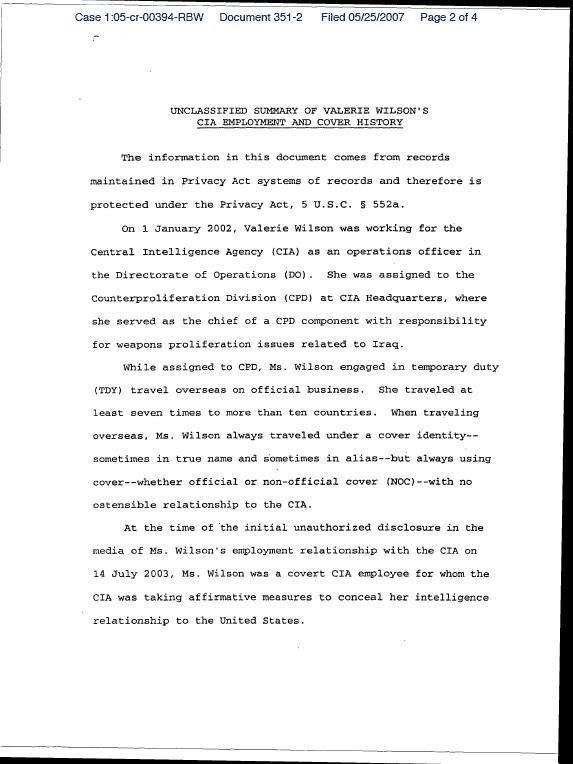
No Surprise, Right Wing Lies : Documents Show Valerie Plame was Covert CIA Operative at the Time of White House Leak

The right-wing has been insisting that Valerie Plame was not a covert operative since someone in the White House leaked her name to Robert Novak almost four years ago. Of course, to knowingly identify a covert CIA operative would be a felony under the Intelligence Identities Protection Act of 1982, passed as a result of the assassination of CIA operative Richard Welch in Athens in 1975, who himself had been outed by Counterspy, a renegade magazine that called for the "neutralization" of spies by taking away their cloak of secrecy. So, of course, the last thing the right-wing in the US would want to admit is that Plame was, in fact, covert.

Guess what? Valerie Plame was, in fact, covert. A covert CIA operative. At the time of the leak. Translation: someone in the White House committed a felony. To read the three-page document for yourself, see it here, at Salon's "Primary Sources."
Photo Sharing and Video Hosting at Photobucket

In Federal Court on Tuesday, special prosecutor Patrick Fitzgerald filed a summary of declassified CIA information that proves that Plame was an active spy, and not, as many on the right have disparagingly remarked, a mere "desk jockey." So, all the defensive posturing, the name-calling, and the disparaging was another example of (surprise!!!) the right-wing LYING TO THE AMERICAN PEOPLE!!!

Who'd have thought it???

Sunday, May 27, 2007

Commencement Round-up: Former Bush Chief-of-Staff Andrew Card Booed Off Stage at UMass; Cheney at West Point Says "Screw Geneva Conventions"

Both grads and faculty wore signs protesting Card's presence. One banner read "Criminals go home." The theme of the day was "Honor grads; Dis-Card."

Beautiful.

Meanwhile, Vice President Dick Cheney told graduating Cadets at West Point that the Geneva conventions should not apply to the (so-called) "war on terror." This comes at a time, bizarre and surreal, that West Point instructors are having difficulty persuading cadets that US soldiers ought to be better than terrorists.

Recently, West Point instructors have complained of the difficulty of persuading Army cadets to adhere to the principles of the Geneva Conventions in the war on terrorism. A February article in the New Yorker highlighted a dialog on the problem between West Point's dean and Joel Surnow, producer of the hit Fox television program '24.'

"This past November, U.S. Army Brigadier General Patrick Finnegan, the dean of the United States Military Academy at West Point, flew to Southern California to meet with the creative team behind '24,'" wrote Jane Mayer in the magazine. "Finnegan, who is a lawyer, has for a number of years taught a course on the laws of war to West Point seniors - cadets who would soon be commanders in the battlefields of Iraq and Afghanistan. He always tries, he said, to get his students to sort out not just what is legal but what is right. However, it had become increasingly hard to convince some cadets that America had to respect the rule of law and human rights, even when terrorists did not. One reason for the growing resistance, he suggested, was misperceptions spread by '24,' which was exceptionally popular with his students. As he told me, 'The kids see it, and say, ''If torture is wrong, what about '24?''"

Saturday, May 26, 2007

More Than 100 US Dead -- So Far -- in Iraq in May

For the second month in a row, US deaths in Iraq have exceeded 100, with 117 in the 30 days of April, 2007, and 106 in the 26 days so far of May, 2007. That brings the total US Death toll to 3,452. Add to that an estimated 398 American mercenaries (or, as they're euphemistically called, "contractors"), and you've got a total of 3,850. Photo Sharing and Video Hosting at Photobucket
This is the first time in the four years of the war that US deaths have exceeded 100 two months in a row. Just like the war itself, the "surge" is working nicely. Don't you think?

Senate Report : CIA Told White House Before US Invasion That Iraq War Would Go Bad, Create a Haven for Al Qa'ida, and Embolden Iran

An Update on the "So-called War on Terror"TM
Photo Sharing and Video Hosting at Photobucket
According to a report released Friday (that hole-in-the-newscycle when no one is paying any attention) by the Senate Select Committee on Intelligence, the CIA warned the White House as early as January 2003 that a US invasion would ignite sectarian violence, give al Qa'ida an opportunity to gain a foothold in Iraq, and embolden Iran to assert its influence further in the middle east.

Are you listening, Howie?

So let me get this straight: the White House knew beforehand, according to the Pentagon, that there was no evidence of WMDs, no evidence that al Qa'ida was operating in Iraq, and that there was no evidence of Iraqi complicity in 9/11; we also knew that an invasion would break Iraq into pieces, spread terrorism, and widen Iran's influence. Do I have that correctly?

So I have two questions:

1] What are we doing there?
2] When are we going to have the courage to IMPEACH BUSH???

Wednesday, May 23, 2007

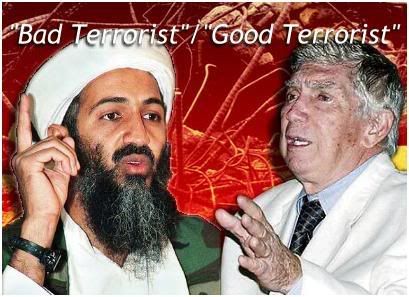
Venezuela : Extradite Terrorist Posada to the OAS

An update on the "New Axis of Evil"TM
Photo Sharing and Video Hosting at Photobucket
Well, as you are probably aware, a Federal Court released terror mastermind Luis Posada Carilles on bail this month pending his trial on illegally entering the country. I'm sure you've been following the story closely in the mainstream media, right? Astounding.

President Bush in a speech to the United Nations some months after the US invasion of Iraq (9/23/03), reminded nations of their responsibilities in bringing terrorists to justice. To shirk those responsibilities in a post-9/11 world, he said, was tantamount to aiding and abetting terrorism.
All governments that support terror are complicit in a war against civilization.

Well, Venezuela says they are serious about those obligations, and since the US won't extradite Posada to either Venezuela or Cuba (ironically because the Bush adminitrsation says the 79 year old may be tortured), then extradite him to the Organization of Amercan States, all of whom have made committments to cooperate with the United States to fight terror.
Fulfillment of the commitments made by the states concerning anti-terrorist efforts, including trial or, as appropriate, extradition of the masterminds of terrorist acts, is an ethical duty and a golden rule in hemispheric cooperation.
Unfortunately, Bush can ignore this suggestion and there will be no public outcry, because the "liberal" media are doing their best to ignore this entire story. But whenever he holds up a picture of some other terror mastermind, the "left-wing" media will be all over it.

Do justice a favor: write a letter to the editor of your local paper and urge them to follow this story and to report on it regularly. Don't let America remain IN THE DARK.

Thursday, May 17, 2007

A Clearer View of Iraq

An Update on the "So-called War on Terror"TM
Photo Sharing and Video Hosting at Photobucket
Our mainstream mass media are serving us poorly, and it doesn't really matter if your politics makes you see them as "corporate media" or as "liberal media" (an idea, I must admit, that I've found laughable and unsupported for a quarter of a century, during which time I spent nearly two decades working at NBC News -- vapid, shallow, obnoxiously self-righteous, yes. Liberal, no). What everyone seems to agree upon, however, is just what a terrible job our mainstream mass media are doing informing us about the world.

That's a start. I hope we can accelerate this process a bit, because people are dying, and we need to know about it so we can do something about it.

To that end I will tell you about a new report, Accepting Realities in Iraq by Gareth Stansfield of Britain's Chatham House (one of the world's leading organizations for the analysis of international issues) and the University of Exeter.

The report argues that US policy in Iraq must change to face a number of realities to which the Bush administration has been blind up until now. Among these realities, the report claims that(emphases mine):
• There is not ‘a’ civil war in Iraq, but many civil wars and insurgencies involving a number of communities and organizations struggling for power. The surge is not curbing the high level of violence, and improvements in security cannot happen in a matter of months.
• The conflicts have become internalized between Iraqis as the polarization of sectarian and ethnic identities reaches ever deeper into Iraqi society and causes the breakdown of social cohesion.
• Critical destabilizing issues will come to the fore in 2007–8. Federalism, the control of oil and control of disputed territories need to be resolved.
• Each of Iraq’s three major neighbouring states, Iran, Saudi Arabia and Turkey, has different reasons for seeing the instability there continue, and each uses different methods to influence developments.
• These current harsh realities need to be accepted if new strategies are to have any chance of preventing the failure and collapse of Iraq. A political solution will require engagement with organizations possessing popular legitimacy and needs to be an Iraqi accommodation, rather than a regional or US-imposed approach.
This all jibes pretty closely with a recent Speigel interview with Stephen Biddle, Senior Fellow at the Council of Foreign Relations, former Professor of National Security Studies at the U.S. Army War College Strategic Studies Institute, and respected military historian.

Biddle told der Speigel that the war we're fighting in Iraq is not an insurgency at all:

...the classical strategy for waging counter insurgency is oriented around winning hearts and minds. You engage in a process of political reform in which you introduce democracy to make the government's ideas legitimate. You engage in a campaign of economic development assistance. And you try and train an indigenous military to wage the war. All those strategies are what the Bush Administration's approach to Iraq has been. They make some sense, if the problem you are trying to solve is a classical ideological insurgency. Except, Iraq is not.

SPIEGEL ONLINE: What is then?

Biddle: It's a communal civil war in which the war is not fought over a set of ideas. Rather, it is about the survival and self interest of communal groups within the nominal state. Sunnis are not fighting for an idea of what's best for all Iraqis; they are not trying to persuade Shiites that a Sunni government would be good for them. They are fighting for the self interest of Sunnis against the self interest of Shiites -- and vice versa. Because it is not a war of ideas you cannot expect to win it by changing people's minds. It's a war of identity. Identities can't change in the way minds can.

You know, you have to fight the war you've got, not the war you wish you had. And we should be fighting a real war on terror, not doing our part to further Al Qa'ida's goals. To wit: Michael Jacobson of the Washington Institute for Near East Policy points out that while the Bush administration's "Iraq policy" (if it can be called that) in the past has conformed to the classic insurgency approach, resulting in a 25% increase in casualties between 2005 and 2006, a new approach might be presenting itself> Citing the State Department's annual report on global terrorism developments, Country Reports on Terrorism 2006, Jacobson observes that (my emphases):
While the United States still must eliminate the leadership of terrorist organizations, the report notes that "incarcerating or killing terrorists will not achieve an end to terrorism." According to the report, one of the most important and challenging aspects of combating terrorism is "addressing the underlying conditions that terrorists exploit," which include "geo-political issues, lack of economic opportunity and political participation, ethnic conflict, ungoverned space, or political injustice."
Sounds like a good idea to me. It ought to, since those of you who read this blog know I've been saying this for years. Those of you who know me even longer than I've been blogging know that this is something I've been saying since the late 1990s.

As for that "ungoverned space" mention in the State Department's report, has anyone been looking at Pakistan lately? As I've mentioned to Howie, when we are hit again by terrorists, the attack is more likely to come from Pakistan than anywhere else.

Wednesday, May 16, 2007

Fight Against Terrorism by Fighting Poverty

The real war on terror isn't going very well yet, but there is some progress being made.
Photo Sharing and Video Hosting at Photobucket
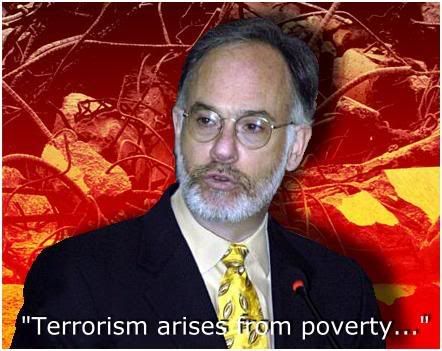
Recently, Terry Davis, Secretary General of the Council of Europe, wrote an article in the Romanian newspaper Jurnalul National cautioning that the current anti-terror tack of the Western developed nations (led by the US and UK) is, at best, imcomplete if it ignores the root causes of terrorism. Now, US Ambassador to Turkey Ross L. Wilson has said the same thing, joining a growing chorus of world leaders and opinion makers, including Philippine Chief Justice Reynato Puno, Peter Munya, the US Conference of Catholilc Bishops, John Edwards, Hugo Chavez, Fernando Lugo, Desmond Tutu, Charles Dickens, Muhammed Yunus, myself, and even Pakistan dictator Gen. Pervez Musharraf . For the record, the late Holy Father Pope John Paul II believed this too. That sounds like a pretty good bunch of people to stack up against the likes of Feith, Wolfowitz, Cheney, Rumsfeld, Kristol, and the rest of the PNAC cabal that persists in Washington. I'll take John Paul II over George W. Bush any day.

Wilson told a conference conducted by the George C. Marshall European Center for Security Studies and the Center of Excellence-Defense Against Terrorism in cooperation with the NATO-Russia Council that
Most people would find it hard to argue against the idea that terrorist violence arises, sociologically speaking, out of poverty, despair, hopelessness and resentment.
It's amazing how many people don't find it all hard to argue this point. To some, terrorism has nothing to do with poverty, it has to do with an evil ideology that seeks nothing but political hegemony. This thinking links up comfortably with the Bush administration's "good vs evil" approach to foreign policy. Besides, they often point out, so many of these terrorists went to school and had jobs...
It is true that terrorist leaders seem more often than not to come from middle-class backgrounds. But terrorists do not just spring forth from Medusa's head, and effective government policy will seldom just involve cutting off terrorism's tentacles. The causes must be considered, and constructive policies must be devised to draw people away from the dead ends of violence and despair.
Yes. Are you listening?