The United Steelworkers Union has officially merged with Unite the Union, the largest labor organization in Ireland and the UK, to continue the growth of globally organized labor. 
• There is not ‘a’ civil war in Iraq, but many civil wars and insurgencies involving a number of communities and organizations struggling for power. The surge is not curbing the high level of violence, and improvements in security cannot happen in a matter of months.This all jibes pretty closely with a recent Speigel interview with Stephen Biddle, Senior Fellow at the Council of Foreign Relations, former Professor of National Security Studies at the U.S. Army War College Strategic Studies Institute, and respected military historian.
• The conflicts have become internalized between Iraqis as the polarization of sectarian and ethnic identities reaches ever deeper into Iraqi society and causes the breakdown of social cohesion.
• Critical destabilizing issues will come to the fore in 2007–8. Federalism, the control of oil and control of disputed territories need to be resolved.
• Each of Iraq’s three major neighbouring states, Iran, Saudi Arabia and Turkey, has different reasons for seeing the instability there continue, and each uses different methods to influence developments.
• These current harsh realities need to be accepted if new strategies are to have any chance of preventing the failure and collapse of Iraq. A political solution will require engagement with organizations possessing popular legitimacy and needs to be an Iraqi accommodation, rather than a regional or US-imposed approach.
You know, you have to fight the war you've got, not the war you wish you had. And we should be fighting a real war on terror, not doing our part to further Al Qa'ida's goals. To wit: Michael Jacobson of the Washington Institute for Near East Policy points out that while the Bush administration's "Iraq policy" (if it can be called that) in the past has conformed to the classic insurgency approach, resulting in a 25% increase in casualties between 2005 and 2006, a new approach might be presenting itself> Citing the State Department's annual report on global terrorism developments, Country Reports on Terrorism 2006, Jacobson observes that (my emphases):...the classical strategy for waging counter insurgency is oriented around winning hearts and minds. You engage in a process of political reform in which you introduce democracy to make the government's ideas legitimate. You engage in a campaign of economic development assistance. And you try and train an indigenous military to wage the war. All those strategies are what the Bush Administration's approach to Iraq has been. They make some sense, if the problem you are trying to solve is a classical ideological insurgency. Except, Iraq is not.
SPIEGEL ONLINE: What is then?
Biddle: It's a communal civil war in which the war is not fought over a set of ideas. Rather, it is about the survival and self interest of communal groups within the nominal state. Sunnis are not fighting for an idea of what's best for all Iraqis; they are not trying to persuade Shiites that a Sunni government would be good for them. They are fighting for the self interest of Sunnis against the self interest of Shiites -- and vice versa. Because it is not a war of ideas you cannot expect to win it by changing people's minds. It's a war of identity. Identities can't change in the way minds can.
While the United States still must eliminate the leadership of terrorist organizations, the report notes that "incarcerating or killing terrorists will not achieve an end to terrorism." According to the report, one of the most important and challenging aspects of combating terrorism is "addressing the underlying conditions that terrorists exploit," which include "geo-political issues, lack of economic opportunity and political participation, ethnic conflict, ungoverned space, or political injustice."Sounds like a good idea to me. It ought to, since those of you who read this blog know I've been saying this for years. Those of you who know me even longer than I've been blogging know that this is something I've been saying since the late 1990s.

Terrorism is terrible enough, but the mindless, knee-jerk reaction to extirpate the evil is more discomforting. One visible result of the scramble to end terrorism is to take legal shortcuts and legal shortcuts always shrink the scope of human rights. These shortcuts have scarred the landscape of rights in the Philippines.Puno said that the institutional forces of anti-terrorism engage in much flag-waving, singing of the national anthem and issuing "high-pitched" directives to military forces, the police, and citizens to use their weapons for victory at all costs. But, he said, enough is enough. Security is meaningless at the expense of individual liberty.
To put constitutional cosmetics to the military-police muscular efforts, lawmakers usually enact laws using security of the state to justify the dimunition of human rights by allowing arrests without warrants; surveillance of suspects; interception and recording of communications; seizure or freezing of bank deposits, assets and records of suspects. They also redefine terrorism as a crime against humanity and the redefinition is broadly drawn to constrict and shrink further the zone of individual rights.Puno urged political leaders -- but the appeal might be read by all of us, if we choose -- to have a broader view of terrorism, saying poverty is also a form of terrorism and the poor suffer more by their poverty than by violence.
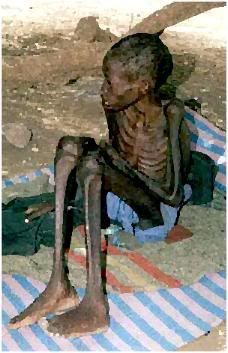
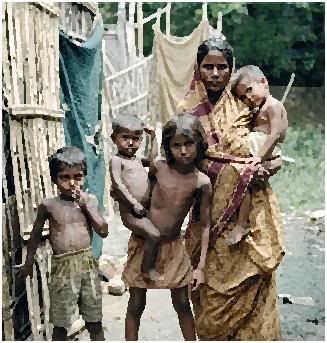
In poor countries, it is poverty that truly terrorizes people for they are terrorized by the thought that they will die because of empty stomachs and not that they will lose their lives due to some invisible suicide bombers...The apathy of those who can make a difference is the reason why violations of human rights continue to prosper. The worst enemy of human rights is not its non-believers but the fence sitters who will not lift a finger despite their violations...Sooner or later, they will find that they who default in protecting the rights of the many will end up without rights like the many...With the incursions and threats of incursion to our human rights at this crucial moment in our history, the clarion call to each one of us is to consecrate our lives to the great cause of upholding our human rights.

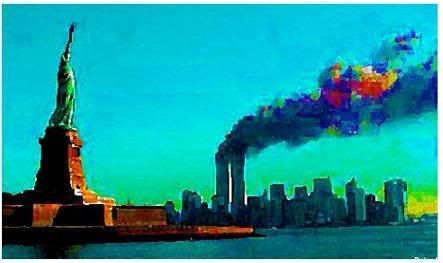
That's reminiscent of the August 6, 2001 Presidential Daily Briefing titled "Bin Laden Determined to Strike in US." Good Lord, how many dots do you have to draw in a straight line before it occurs to George W. Bush's administration to connect them???The newspaper says it has obtained 328 pages of classified documents that show foreign agents infiltrated al-Qaeda's network.
It produced nine reports between September 2000 and August 2001, including the January 2001 document called 'Plan to hijack an aircraft by Islamic radicals'.
Le Monde said the January 2001 report was handed over to a CIA operative in Paris, but that no mention of it was made in the official US September 11 Commission which produced its findings in July 2004.Why was that? Don't we deserve an explanation?
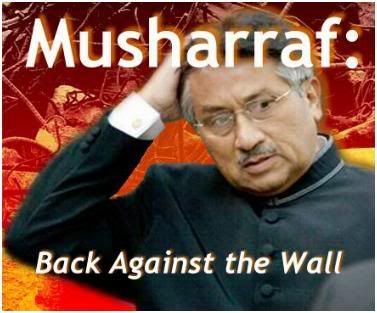
Le Monde said the documents also show the French believed al-Qaeda leader Osama bin Laden was still receiving help from family members and senior officials in Saudi Arabia in advance of the 11 September attacks.Yes. Like Pakistan's dictator Gen. Pervez Musharraf, the Saudis are our allies.

Let me repeat and emphasize that last part: Terrorism is a state of mind that cannot be countered with force and needs a long-term strategy and total understanding of its underlying causes.President Musharraf urged the developed and industrialized States to help the Islamic countries in their socio-economic development as the extremism stems from poverty.
The President re-emphasized Pakistan's firm resolve to combat terrorism frontally and militarily but said that joint efforts were needed by the global community in achieving the objective of defeating the menace. He pointed out that extremism is a state of mind and could not be countered with force and needs a long-term strategy and total understanding of underlined causes which spawn the scourge.
The President said that the poverty, illiteracy and misinterpretation of Islamic knowledge are the other inherent causes contributing to the rise of extremism.Yes. Pakistan has only a 48% literacy rate -- 35% female literacy. Perhaps Musharraf will funnel some money into educating Pakistan's citizens? A quarter of Pakistan lives below the poverty level -- the Pakistani poverty level. Child labor is common there. Pakistan has a per capita gross domestic product of $2,600. To put that into perspective, Iraq -- in the midst of a bloody civil war, mounting insurgency, and daily chaos, has a per capita GDP of $2,900.
(Musharraf) said two-pronged strategy on the one hand calls upon the Muslim States to shun extremism and go on the path of socio-economic development and on the other called upon the West, especially the United States , to help resolve outstanding disputes and assist in economic development of Islamic countries. (my emphasis)Like it or not, folks, we are our brothers' keeper. From those to whom much is given, much is expected.
This era of global apathy and global greed has to end. This era of global, un-regulated, laissez faire, "free-market" capitalism has to end. Rational regulation was just as much a part of Adam Smith's vision as irrational speculation.Whenever the Government supports laws to combat global terrorism, it routinely invokes UN guidelines on the subject as a rationale, even when that sometimes means restricting the civil liberties of New Zealanders. Yet when it comes to UN initiatives aimed at combating global poverty, the Government has been willing to drag its feet.
In years past, the Prime Minister Helen Clark has acknowledged the links that exist between terrorism and its breeding grounds in poverty, inequality, disease and lack of opportunity. The Government should be treating global poverty with the same urgency it currently affords to global terrorism.
The new leaders rose from within the organization after the death or capture of the operatives that built Al Qaeda before the Sept. 11, 2001, attacks on the United States. This has led to surprise and dismay within U.S. intelligence agencies about the group's ability to rebound from an American-led offensive.Perhaps if we had maintained that offensive pressure -- and exerted some pressure on the likes of Pakistan's dictator Gen. Pervez Musharraf -- instead of bailing out to fight an unnecessary war in Iraq, we wouldn't be feeling all this "surprise" and "dismay."
The evidence officials said was accumulating about (ascending terrorist leader Abu Ubaidah al-)Masri and a handful of other Al Qaeda figures has led to a reassessment within the U.S. intelligence community about the strength of the group's core in Pakistan's tribal areas, and its role in some of the most significant terrorism plots of the last two years, including the airline plot and the suicide attacks in London in July 2005 that killed 56 people.So al Qa'ida has survived the "American-led offensive" (which included the "fumbled" opportunity at Tora Bora) in Afghanistan, they have a safe haven in Pakistan, and --SURPRISE!!! -- they have gained a foothold in Iraq.
Yes. Thanks to George W. Bush and his friends, like Pakistan dictator Pervez Musharraf.Experts say they still see Al Qaeda in Mesopotamia as largely independent of Al Qaeda's hub in Pakistan but that they believe the fighting in Iraq will produce future al Qaeda leaders. "The jihadis returning from Iraq are far more capable than the mujahedeen who fought the Soviets ever were," said Robert Richer, who was associate director of operations in 2004 and 2005 for the CIA. "They have been fighting the best military in the world, with the best technology and tactics."
"To say that Al Qaeda was out of business simply because they have not attacked in the U.S. is whistling past the graveyard," said Michael Scheuer, a former head of the bin Laden tracking unit at the CIA. "Al Qaeda is still humming along, and with a new
generation of leaders."

Do not forget or neglect the needs of the poor and vulnerable in the United States and throughout the world in setting budget priorities, U.S. bishops urged Congress, noting that they have responsibility to meet the common good.Common good? You still talking about that? Didn't we get rid of that useless concept in the 1980s? No, say the Bishops. Decisions about spending have to be made on the basis of more than "economic policy."
“Meeting essential human needs is a compelling ethical and fiscal priority,” he said. “A moral measure of the budget will be how it treats poor and vulnerable people.”The Bishops questioned the morality of tax cuts that benefit the rich while putting an undue burden on the middle class and jeopardizing the well-being of the poor.
“When the basic requirements of human life and dignity for many in our country and throughout the world go unmet, it is essential that adequate federal revenues be available to help meet these basic human needs,” he said.Deficit spending on things like, well, war also limit the amount of money that can be spent on providing for the common good.
The budget should, he said, provide “adequate funding” for programs that help families “escape hunger and homelessness, find decent housing and employment and have access to quality education and medical care.”This is important not just at home; the common good extends beyond our shores.
He also pointed to strengthening the U.S. government commitment to foreign aid, including relief, developmental and health-care assistance throughout the developing world “where people live with crushing poverty and diseases” and forced to flee “violence and persecution.” “Your budget choices have clear moral and human dimensions,” he said. “They reflect our values as a people.”Amen.
“The weak and vulnerable,” he said, “do not have powerful lobbyists.”Alleluia.
The war on terror will "never" be won "as long as there are conditions in the world that make people desperate," like dehumanising poverty, disease and ignorance...Despite Bush administration and neo-conservative assertions to the contrary, both terrorism and the (so-called) "war on terror" are necessary by-products of the "culture of death," a culture where self-interest predominates at the expense of the common good.
Tutu emphasised that the "fundamental law of our being" is that "we are bound to one another". Because of that, "the only way we can make it is together, all of us". Only together can we be free, safe and secure.It is a founding principle of the Project for a New American Century -- one taken up by the Bush administration (if that is not redendant) -- that American military power and our status as the sole global superpower give us the ability and obligation to spread American values around the world. And that's fine, as long as we know clearly what our values are. Bush and the "religious" right in the US claim to stand for a "culture of life." They "talk the talk," but their walk is kind of crooked.
Amen."God is weeping," Tutu told the ecumenical gathering at Nairobi's Holy Family Roman Catholic Basilica, at the sight of the awful things happening in the world today.
"God weeps and says: 'Who will help me so we can have a different kind of world, one in which the rich know they have been given much so they can share and help others?'" A creation that was very good has "turned into a nightmare".