Showing posts sorted by relevance for query gore. Sort by date Show all posts

Tuesday, January 17, 2006

Al Gore Hits a Nerve

Al Gore's speech yesterday, sponsored by the American Constitution Society for Law & Policy and the Liberty Coalition, seems to have touched a very raw nerve on the right.

Image hosted by Photobucket.com

The speech, delivered at the Daughters of the American Revolution Hall in Washington, DC, and ignored by the "liberal media" (where DO you get these crazy ideas, Howie?), was greeted with thunderous applause from both Democrats and Republicans (unlike Bush, Gore invites bi-partisan audiences) when he called for a special prosecutor to investigate the President's "repeated and persistent" breaking of the law.

The defenders of torture, however, take offense.

From the National Review Online, Byron York tells of Al Gore's Mad Messsage.

ABC News notes that the White House Accuses Gore of Hypocrisy.

The American Thinker (oh, puh-LEASE!!!) had the audacity to claim that Al Gore dishonors Dr. King's memory, as though the great Christian non-violent civil rights and peace activist would NOT have said the same thing as Al Gore.

NewsMax.com published--almost verbatim--the RNC's inaccuracy-plagued (how's that for a tortured euphemism?) press release under the pathetic title, GOP Hits Back at Al Gore on Wiretapping.

I've said it before, I'm saying it again: Re-elect Al Gore in 2008!!!

Wednesday, October 12, 2005

Draft Gore in 2008

As if in answer to my suggestion, former Vice President Al Gore says he will not be a candidate for President in 2008--or ever.

But in one of the understatements of the millenium, he says that the United States would be a "different country" had he been elected in 2000.*

"We would not have invaded a country that didn't attack us," he said, referring to Iraq. "We would not have taken money from the working families and given it to the most wealthy families."

"We would not be trying to control and intimidate the news media. We would not be routinely torturing people," Gore said. "We would be a different country."


Gore has not closed the door entirely to running for elective office in the future.
"I don't completely rule out some future interest, but I don't expect to have that," Gore said.

The man should be President right now.

*Note to Mr. Gore: YOU WERE ELECTED IN 2000.

Tuesday, May 22, 2007

Al Gore : Media Ecologist

Photo Sharing and Video Hosting at Photobucket
This comes from former Vice President Al Gore's new book, The Assault on Reason, excerpted in this week's TIME magazine. I post these excerpts here for a number of reasons: 1] it is inherently newsworthy; 2] it makes use -- deliberately or not -- of principles of the field of Media Ecology (and I have reason to believe that this use was deliberate); 3] he makes many of the same points as I do here in this blog, noting that people of good will will "do the right thing" when they are in possession of good information; and 4] Gore demonstrates once again that he is, beyond question, one of the most intelligent people in the public sphere today. The man ought to be president!!!

He begins by lamenting the nature of politics in the post-modern United States (all emphases throughout these excerpts are mine):

..."Why do reason, logic and truth seem to play a sharply diminished role in the way America now makes important decisions?" The persistent and sustained reliance on falsehoods as the basis of policy, even in the face of massive and well-understood evidence to the contrary, seems to many Americans to have reached levels that were previously unimaginable....

American democracy is now in danger—not from any one set of ideas, but from unprecedented changes in the environment within which ideas either live and spread, or wither and die. I do not mean the physical environment; I mean what is called the public sphere, or the marketplace of ideas....

While American television watchers were collectively devoting 100 million hours of their lives each week to these and other similar stories (O.J. Simpson, Michael Jackson, Laci Peterson, Robert Blake, Paris Hilton, etc.), our nation was in the process of more quietly making what future historians will certainly describe as a series of catastrophically mistaken decisions on issues of war and peace, the global climate and human survival, freedom and barbarity, justice and fairness. For example, hardly anyone now disagrees that the choice to invade Iraq was a grievous mistake. Yet, incredibly, all of the evidence and arguments necessary to have made the right decision were available at the time and in hindsight are glaringly obvious....

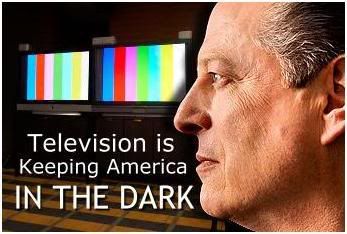
Gore comes perilously close to writing the book I've been writing for the last several years, and it is certainly on my reading list. I look forward to its publication, even if (or, perhaps, especially if) it replicates my own ideas. His book will certainly get a far wider reading than anything I might ever write could, and his message (and mine) is too important to be left IN THE DARK.

Our Founders' faith in the viability of representative democracy rested on their trust in the wisdom of a well-informed citizenry, their ingenious design for checks and balances, and their belief that the rule of reason is the natural sovereign of a free people. The Founders took great care to protect the openness of the marketplace of ideas so that knowledge could flow freely. Thus they not only protected freedom of assembly, they made a special point—in the First Amendment—of protecting the freedom of the printing press. And yet today, almost 45 years have passed since the majority of Americans received their news and information from the printed word. Newspapers are hemorrhaging readers. Reading itself is in decline. The Republic of Letters has been invaded and occupied by the empire of television....
Gore makes it pretty clear that not only is he familiar with the works of Neil Postman, founder of the NYU's Media Ecology program, but he is also familiar with the principles regarding the operation of media and their consequences for the user:

In the world of television, the massive flows of information are largely in only one direction, which makes it virtually impossible for individuals to take part in what passes for a national conversation. Individuals receive, but they cannot send. They hear, but they do not speak. The "well-informed citizenry" is in danger of becoming the "well-amused audience." Moreover, the high capital investment required for the ownership and operation of a television station and the centralized nature of broadcast, cable and satellite networks have led to the increasing concentration of ownership by an ever smaller number of larger corporations that now effectively control the majority of television programming in America.

In practice, what television's dominance has come to mean is that the inherent value of political propositions put forward by candidates is now largely irrelevant compared with the image-based ad campaigns they use to shape the perceptions of voters....

As a result, our democracy is in danger of being hollowed out. In order to reclaim our birthright, we Americans must resolve to repair the systemic decay of the public forum. We must create new ways to engage in a genuine and not manipulative conversation about our future. We must stop tolerating the rejection and distortion of science. We must insist on an end to the cynical use of pseudo-studies known to be false for the purpose of intentionally clouding the public's ability to discern the truth. Americans in both parties should insist on the re-establishment of respect for the rule of reason....

Gore then invokes the name of one of the founding fathers -- certainly the best known of the founding fathers -- of the entire field of media studies:

To understand the final reason why the news marketplace of ideas dominated by television is so different from the one that emerged in the world dominated by the printing press, it is important to distinguish the quality of vividness experienced by television viewers from the "vividness" experienced by readers. Marshall McLuhan's description of television as a "cool" medium—as opposed to the "hot" medium of print—was hard for me to understand when I read it 40 years ago, because the source of "heat" in his metaphor is the mental work required in the alchemy of reading. But McLuhan was almost alone in recognizing that the passivity associated with watching television is at the expense of activity in parts of the brain associated with abstract thought, logic, and the reasoning process. Any new dominant communications medium leads to a new information ecology in society that inevitably changes the way ideas, feelings, wealth, power and influence are distributed and the way collective decisions are made....
Or, as McLuhan put it, "the medium is the message." And the consequences (the "message") of the social change brought about by television on a democratic polity have been dire:

Many young Americans now seem to feel that the jury is out on whether American democracy actually works or not. We have created a wealthy society with tens of millions of talented, resourceful individuals who play virtually no role whatsoever as citizens.
I would go a step further here and suggest that one of the consequences of the commoditization of information and the increasing commercialization of what is actually and ought to be seen as the uniquely human activity -- communication -- is that we have ceased to even see ourselves as citizens. We are now nothing more than consumers -- consumers not in a marketplace of ideas, but of impressions.

Bringing these people in—with their networks of influence, their knowledge, and their resources—is the key to creating the capacity for shared intelligence that we need to solve our problems....

Fortunately, the Internet has the potential to revitalize the role played by the people in our constitutional framework. It has extremely low entry barriers for individuals. It is the most interactive medium in history and the one with the greatest potential for connecting individuals to one another and to a universe of knowledge. It's a platform for pursuing the truth, and the decentralized creation and distribution of ideas, in the same way that markets are a decentralized mechanism for the creation and distribution of goods and services. It's a platform, in other words, for reason....

The democratization of knowledge by the print medium brought the Enlightenment. Now, broadband interconnection is supporting decentralized processes that reinvigorate democracy. We can see it happening before our eyes: As a society, we are getting smarter. Networked democracy is taking hold. You can feel it. We the people—as Lincoln put it, "even we here"—are collectively still the key to the survival of America's democracy.

Why isn't this man President?

The next time you hear someone taking a shot at Gore because he is "wooden," or "stiff," or "boring," the next time you hear them parroting claims that are just not true, but have been repeated so many times -- on television -- that lazy-minded people believe them, rest assured in the knowledge that you are dealing with one of those very same lazy-minded people -- TV people. And then learn about your world, and vote for candidates that will make it better.

Democracy pointless? Only if you believe it to be.

DRAFT GORE FOR 2008!!!

Thursday, October 06, 2005

Al Gore on TV, War, and Social Apathy

The man should have been President.

At the "We Media" conference yesterday in New York, Al Gore warned America that its democracy is in "grave danger" due to the distorting effects of mass media, particularly television, a medium that "completely dominates the flow of information in modern America."

How many of you, I wonder, have heard a friend or a family member in the last few years remark that it's almost as if America has entered "an alternate universe"?

I thought maybe it was an aberration when three-quarters of Americans said they believed that Saddam Hussein was responsible for attacking us on September 11, 2001. But more than four years later, between a third and a half still believe Saddam was personally responsible for planning and supporting the attack.


Sounding as though he ought to have a blog called IN THE DARK, the Vice President questions the increasing detachment of American citizens to the world around them:
Are we still routinely torturing helpless prisoners, and if so, does it feel right that we as American citizens are not outraged by the practice? And does it feel right to have no ongoing discussion of whether or not this abhorrent, medieval behavior is being carried out in the name of the American people? If the gap between rich and poor is widening steadily and economic stress is mounting for low-income families, why do we seem increasingly apathetic and lethargic in our role as citizens?

The Vice President has a great deal of enthusiadm for the promise of the internet (as do I), and believes we must work to keep it free of corporate control:

We must ensure that the Internet remains open and accessible to all citizens without any limitation on the ability of individuals to choose the content they wish regardless of the Internet service provider they use to connect to the Worldwide Web. We cannot take this future for granted. We must be prepared to fight for it because some of the same forces of corporate consolidation and control that have distorted the television marketplace have an interest in controlling the Internet marketplace as well. Far too much is at stake to ever allow that to happen.

We must ensure by all means possible that this medium of democracy's future develops in the mold of the open and free marketplace of ideas that our Founders knew was essential to the health and survival of freedom.


Yes, I'll say it:

GORE IN 2008!!!

Wednesday, February 16, 2005

Al Gore, Global Warming and Moral Leadership

"America needs to join the 'coalition of the willing'"

"Gore called Bush's climate change denial a 'stunning display of moral cowardice,' and said that Bush 'has his head in the sand.' Weapons of mass destruction in Iraq and social security are two false crises that Bush has promoted while he abdicates any leadership on the real crisis of global warming."

Tell 'em, Al.

Tuesday, May 29, 2007

Media Ecology Makes Its Way into Mass Consciousness Via Pop Culture

This was sent to me by someone who has seen my YouTube page and liked the media ecology-related videos. It turns out he is a McLuhan/Postman fan (by interest, not be training). He has a pretty good idea of what is wrong with post-modern culture -- as does Al Gore (see also here), and Roger Waters. I think it is worth looking at. Take a look, too, at The Spectacle's website, and drop them a note to tell them what you think. Tell 'em Dr. Fallon sent you.

By the way, Eric Goodman is the creative genius behind The Spectacle, having written the music and lyrics, and editing this video.

Saturday, March 22, 2008

Barack Obama for President


I've been thinking about this a lot, and I've come to a decision: For me, it's Obama, or no one.

I'm not kidding myself, deluding myself about the neglible impact this blog has: in about three and a half years, about 39,000 pages have been read by about 23,000 people, of whom 16,000 have returned at least once; several dozen people read the blog regularly, returning at an average of four per day. So what I'm about to say should not be read in the sense that I believe it will make any sort of difference. It's not about that. It's not about me. It is not about this blog. It is merely a statement of conviction.

Unless Hillary Clinton wins the not only the superdelegate count, but the delegate count, the greatest number of states, and the raw vote total, I will not vote for her in the upcoming election. I will not be a party (if you will) to the high-jacking of democracy. I've had it with political gamesmanship, horse races, strong-arm tactics, and cynicism. I think Bill Richardson has had it with all those things, too, and that's why he took an enormous chance (if Obama loses, does Richardson have much of a future in a Clinton-dominated Democratic Party?) and endorsed Barack Obama. I hope Al Gore, John Edwards, and more prominent Democrats do in the days to come.
If, at the end of this process, Hillary does legitimately win the Democratic nomination for Presdident of the United States of America, I will, of course, vote for her. Even though I thought Bill Clinton was only a good President and not a great one (and he was more a Republican than a Democratic President), I am not a mindless Clinton-hater. I voted for Hillary Clinton as my Senator when I lived in New York in 2000. And I felt proud and privileged to do so.
But if Hillary Clinton wins this nomination without the greatest number of votes, the greatest number of states, and the greatest number of delegates, but because of some residual power of the spineless DLC faction within the Democratic Party, because of deal-making and arm-breaking, because of the sort of back-room politics that tainted the Democratic image in the last century, you can count me out.
I will not vote for Hillary Clinton.
I've seen too much excitement in the Democratic Party in the last year -- too many new voters, too many younger voters, too many first-time voters, too many voters who were, not long ago, too jaded and cynical to even trust the system -- to have it destroyed by political maneuvering and shenanigans. To be sure, some of the excitement is the result of our first female candidate for President of the United States. But there is more than a little evidence (see, for example, here, here, and here) that her candidacy is getting help from Republicans who are mortally afraid of a Barack Obama candidacy.
But the numbers, as of now, are on Barack Obama's side. And that's where I am standing. If the numbers continue to favor Obama, but he is not nominated, I will not vote for McCain. I Will not vote for Hillary Clinton. I may vote for Ralph Nader.
Note: Please tell your Democratic Party leaders in your area that you don't want any nonsense. The nominee of the Democratic Party should be the person who wins the primary campaign -- the whole campaign. If you feel the way I do, that to give the nomination to anyone who doesn't win it outright is wrong, and that you won't vote for an illegitimate nominee, please tell them that.

Tuesday, April 08, 2008

The Anti-Intellectualism of Denial

Now hear this, America:

"Liberal fascism" is behind the concern for global warming. This is what the right -- and many "Libertarians" -- would have you believe about anyone who is concerned that we Americans be responsible stewards of God's creation. We "liberals" who voice a concern about the quality of the environment are not Christians, but rather "fascists."

Wow. I'm a fascist. Far out.

Despite the fact, however, that in July 2001 President George W. Bush stated clearly that "my Administration’s climate change policy will be science-based," the record of his administration has been one of resisting science, obfuscating scientific facts, and denying the reality of climate change. Despite a report of the National Academy of Sciences (commissioned by the Presaident) which affirmed and supported the findings of the report of the Intergovernmental Panel on Climater Change, the Bush administration dug in its heels and denied the best science it had at its disposal. White House aides who were recruited from the American Petroleum Institute, a trade groups representing the oil industry, re-wrote US Government climate reports to obscure obvious links between fossil fuel consumption and greenhouse gas build-up.

Why? Simple: environmentalism is bad for business. So much for responsible Christian stewardship.

Federal agencies, under pressure by the Project for a New American Century and its functionaries in the Bush Administration have distorted science for political purposes. The Environmental Protection Agency’s main global warming website and its Global Change Research Program site have both been censored in recent years, even thought the US State Department's own website dealing with climate change has admitted that global warming is a real phenomenon caused by human consumption.

But after four years of internal censorship, the pressure of truth has overwhelmed the political pressure to lie about climate change, and the EPA has offered us some facts about global warming. Let me repeat this: the Environmental Protection Agency, right now, under the Bush regime is saying the following things about global warming:
  • Human activities are changing the composition of Earth's atmosphere. Increasing levels of greenhouse gases like carbon dioxide (CO2) in the atmosphere since pre-industrial times are well-documented and understood.

  • The atmospheric buildup of CO2 and other greenhouse gases is largely the result of human activities such as the burning of fossil fuels.

  • An “unequivocal” warming trend of about 1.0 to 1.7°F occurred from 1906-2005. Warming occurred in both the Northern and Southern Hemispheres, and over the oceans (Intergovernmental Panel on Climate Change, 2007).

  • The major greenhouse gases emitted by human activities remain in the atmosphere for periods ranging from decades to centuries. It is therefore virtually certain that atmospheric concentrations of greenhouse gases will continue to rise over the next few decades.

  • Increasing greenhouse gas concentrations tend to warm the planet.

What explains this craziness? Nothing new, actually, in American history; we've all seen this movie before. It's just good old-fashioned American anti-intellectualism.

This is the same anti-ntellectualism that says creationism is a "science." The same anti-intellectualism that says (as David Horowitz says) that academia is a haven for left-wing, revolutionary rhetoric. The same anti-intellectualism that said, in 2000, Al Gore is a boring snob, and George W. Bush is "regular folk." The same anti-intellectualism that fuels our image-driven (and therefore money-driven) political system.

Don't buy into this, folks. Read the science, which even the Bush administration concedes is real. Global warming is actually happening. So what do we do about it?

Thursday, September 04, 2008

Republican National Convention, Night Four

Update #1, 8:10 pm (CDT): Lindsay Graham is a creepy, lying twit. More to follow.
Update #2, 7:00 am (CDT) 9/5/08:

I am profoundly ambivalent about this post, and this is one of the reasons why I waited until this morning to sit down and write. I needed to let last night's speech roll around in my head and try to figure out what, exactly, it meant to me. I don't think the Republicans sitting in the convention hall in St. Paul had this reaction; indeed, that is one of the defining differences between Democrats and Rpublicans.

There is this kind of knee-jerk, "America first," my-country-right-or-wrong thing that many Americans have grown up calling "patriotism" that isn't necessarily patriotism at all. The Republican Party is filled with people these days who have exactly this definition of patriotism. But that's not necessarily what patriotism actually is. In fact, the type of love-it-or-leave-it, USA!USA!USA!-chanting patriotism that we've experienced since the Reagan years is what is ultimately behind the crippling partisanism we're suffering through right now. Country, rather than principle, can become an ideology, and when that happens, bad things usually follow. As David Hume said, "The heights of popularity and patriotism are still the beaten road to power and tyranny; flattery to treachery; standing armies to arbitrary government; and the glory of God to the temporal interest of the clergy." That's what Democrats are against. That's what I'm against, and I'm going to keep talking about it, beacuse as Barbara Ehrenreich has told us, "No matter that patriotism is too often the refuge of scoundrels. Dissent, rebellion, and all-around hell-raising remain the true duty of patriots."

So let me raise some hell.

John McCain is an upstanding guy and a true patriot. I remember when he returned with other POWs at the end of the Vietnam war. I remember -- even though I had shifted from staunchly pro-war to vehemently anti-war between 1968 and 1972 -- being in awe of his courage and strength having endured imprisonment, isolation, and torture for so long. It's not something I think I could have endured myself without breaking, dying, or losing my mind.

But John McCain is not the right man for this job, not now. I would have been quite satisfied (though not happy) if he had won the GOP nomination in 2000 and beat Al Gore in the general election to become President. Because unlike George W. Bush (whose disgusting campaign, engineered by talking pig Karl Rove, smeared and abused McCain and his family), John McCain is a decent man.

So last night, whenever he talked about his experiences as a POW, I was moved and silent. I will never lose my respect or my gratitude for John McCain for enduring what he did in Vietnam.

But when he talked about the things he really stands for, I found myself yelling at the television, "NO! He can't be our next president."

These are tough times for many of you. You’re worried about keeping your job or finding a new one, and are struggling to put food on the table and stay in your home. All you ever asked of government is to stand on your side, not in your way. And that’s just what I intend to do: stand on your side and fight for your future.

Except that this is not true. That is exactly not what John McCain intends to do. It has become very clear that John McCain -- either cynically, or through mis-placed faith -- intends to maintain the same neo-liberal economic policies that have so many people worried about keeping their jobs, finding a new one, and struggling to put food on their tables and stay in their homes.

McCain is still a dyed-in-the-wool supply-sider who believes in lower taxes (this is NOT as great as it sounds, since -- as we've seen in the last eight years -- the middle class don't really benefit much from a $200 break in their taxes, but the wealthy do; and all the while the government has less revenue to serve its citizens), incentives for investment (big investors are STILL making money while most Americans are sucking wind), the removal of "barriers" to trade, and "free and open" (i.e., unregulated) markets -- which will mean even more jobs being moved overseas.

Let's be honest: for all they tried to hide it this week, this is still the Republilcan Party. And John McCain may be running as "the Anti-Bush," but he's still a Republican. And these are, since the Reagan years, core Republican values. Not the welfare of the Aerican people, but the welfare of American business.


I fought for the right strategy and more troops in Iraq, when it wasn’t a popular thing to do. And when the pundits said my campaign was finished, I said I’d rather lose an election than see my country lose a war.


Thanks to the leadership of a brilliant general, David Petraeus, and the brave men and women he has the honor to command, that strategy succeeded and rescued us from a defeat that would have demoralized our military, risked a wider war and
threatened the security of all Americans.


The 800 pound elephant in the room, the man behind the curtain, the dirty secret behind this example of pretty-dog-gone-effective propaganda is that "the surge" has not worked. It is not working as we speak. And as we will find out on October 1, it will never work. When will we, in our culture-centric, teflon-coated, chrome-plated, fossil fuel-consuming bubbles admit to ourseves that Iraq is not America, Iraqis are not Americans (or even Europeans), western techniques does not equal eastern technique, our values are not their values?

Let me tell you why the surge isn't working.

At about the same time that John McCain (and Joe Lieberman) was supporting George W. Bush's request to send an additional 5 brigades to Iraq, the US military was negotiating with Sunni fighters (who made up the bulk of the insurgency) to stop fighting with us. Many of the Sunni fighters belonged to what are called "Awakening Councils, " regional quasi-political/religious groups who feared and resented the US-backed creation of a Shiite government. The US military managed to negotiate a semi-official status for the Sunni Awakening groups with the Shiite-led Iraqi Government.

Regional Awakening Groups now police local areas and each member gets paid a monthly stipend by the US Government of about $30 per month -- and in Iraq right now, that's a lot of money. So there has been, during the same time the "surge" has been in place, both a pragmatic compromise giving political legitimacy to groups that are, for all intents and purposes, sectarian militias, and a financial incentive not to kill Americans to the 100,000 (and growing) members of the Awakening groups.

But that will all end on October 1, when direct responsibility for, and authority over, the Sunni Awakening Councils will pass from US hands to the Shiite-controlled Iraqi government. There will be an almost immediate upturn in violence, because the Shiites never saw recognition of the Awakening groups as anything more than a stop-gap measure in helping the US military appear to be gaining control so that a timetable for withdrawal could be set. Their semi-official status will disappear, as will their stipends, and they will return to attacking Shiites and US troops.

The docile US mass media will report it as the US Government describes it -- not as a failure of the surge, but as some "new" problem between "extremists" or "terrorists" and the "legitimate government of Iraq." But make no mistake about it -- the regional, tribal, and sectarian hatred that was unleashed the moment we invaded Iraq and deposed Saddam Hussein never went away as a result of this "surge," and has not abated as a result of it.

I fight to restore the pride and principles of our party. We were elected to change Washington, and we let Washington change us. We lost the trust of the American people when some Republicans gave in to the temptations of corruption. We lost their trust when rather than reform government, both parties made it bigger. We lost their trust when instead of freeing ourselves from a dangerous dependence on foreign oil, both parties and Senator Obama passed another corporate welfare bill for oil companies. We lost their trust, when we valued our power over our principles.

(~~channeling Ronald Reagan~~) Well, there you go again!

It's not exactly the way you explain it, Sen. McCain. The Republican Party lost the trust of the American people when Republicans gave into the temptation of corruption, to be sure. But the Republicans also lost the trust of the American people when they lied about a war, mishandled its conduct, began torturing prisoners, ignored the Geneva Conventions, denied prisoners due process of law, abandoned habeus corpus, and weakened our Constitutional human rights.

It is the GOP in the last eight years, not the Democratic Party, that has increased the size of government, and the level of government spending, and the size of the national debt, and our indebtedness to nations like China.

Obama and the Democratic Party have been in the forefront of the fight to fund research into alternative energy sources. Obama voted for the legislation McCain referred to because, in fact, it included a promise of funding for alternative energies. Obama attached an amendment to this bill calling for the stripping of the tax breaks for the oil and gas companies, but the amendment was defeated. In the end, Obama voted for the bill because of the promise of funding for research into new sources of energy.


Education is the civil rights issue of this century. Equal access to public education has been gained. But what is the value of access to a failing school? We need to shake up failed school bureaucracies with competition, empower parents with choice, remove barriers to qualified instructors, attract and reward good teachers, and help bad teachers find another line of work.


When a public school fails to meet its obligations to students, parents deserve a choice in the education of their children. And I intend to give it to them. Some may choose a better public school. Some may choose a private one. Many will choose a charter school. But they will have that choice and their children will have that opportunity.


Wow. "Education is the civil rights issue of this century." Is that ever a carefully coded sentence. Equal access to public education has been gained, but not equal access to equal resources. Segregation caused by racist, red-lining marketing practices in the real estate industry, to say nothing of the lingering racism that remains in American society, yields poverty-stricken neighborhoods and areas without a sufficient tax base to fund quality schools with good teachers, books, and equipment.

No, Senator McCain, civil rights is the civil rights issue of the 21st century, as it was of the 20th. Stop blaming teachers. Teachers -- especially teachers in the poorest areas in America -- rank alongside POWs in my esteem as America's greatest patriots. Oh, yeah -- and librarians too, Governor Palin. Stop using teachers as a scape goat for underfunded schools and for families that think you can use television as a babysitter for the first six years of their lives and they'll still be prepared for a literate education.

And stop holding out symbolic tokens to families who don't want their children to go to school with black and hispanic children. Stop trying to entice parents who don't want their children to learn about science in science class. I don't want my tax dollars going to schools of this type, or to home schooling moms who teach their children that Jesus is a Republican and President Bush was sent by God to lead us after 9/11. Believe what you want, teach your children what you want, but don't ask me to subsidize your kids' religious educations.

We have dealt a serious blow to al Qaeda in recent years. But they are not defeated, and they’ll strike us again if they can.

To me, this was one of the most egregious, misleading pieces of innuendo of McCain's entire speech. We have not"dealt a serious blow" to al Qa'ida. Al Qa'ida is not a nation, not an army. It has no command structure, no political structure. It can't be "dealt a serious blow" through military means, it can only be made stronger, because al Qa'ida is an idea.

Far from "dealing a serious blow" to al Qa'ida, we have helped them and made them stronger. The 2007 National Intelligence Estimate, "The Terrorist Threat to the US Homeland" confirms this, and I don't understand how McCain can make this amazingly deceitful claim. The report describes how the Iraq war has increased the strength, numbers, and support of al Qa'ida outside the developed world.

The answer to the problem of terrorism in the 21st will not be a military response, any more than it was the answer in the 20th century in Ireland, in Germany, in Italy, in Basque Spain. John McCain, noble and heroic veteran of the Vietnam war doesn't get it. I wish heroes read histories.

I appreciated McCain's exhortation, at the end of his speech, to stand up and fight for America. It was one of the best pieces of hortatory rhetoric I've heard since Henry V (Shakespeare's play -- I don't actually remember Henry V personally):

Once more unto the breach, dear friends, once more,
Or close the wall up with our English dead!
In peace there's nothing so becomes a man
As modest stillness and humility,
But when the blast of war blows in our ears,
Then imitate the action of the tiger:
Stiffen the sinews, summon up the blood,
Disguise fair nature with hard-favored rage;
Then lend the eye a terrible aspect:
Let it pry through the portage of the head
Like the brass cannon; let the brow o'erwhelm it
As fearfully as doth a gallèd rock
O'erhang and jutty his confounded base,
Swilled with the wild and wasteful ocean.
Now set the teeth and stretch the nostril wide,
Hold hard the breath and bend up every spirit
To his full height! On, on, you noble English,
Whose blood is fet from fathers of war-proof,
Fathers that like so many Alexanders
Have in these parts from morn till even fought
And sheathed their swords for lack of argument.
Dishonor not your mothers; now attest
That those whom you called fathers did beget you!
Be copy now to men of grosser blood
And teach them how to war! And you, good yeomen,
Whose limbs were made in England, show us here
The mettle of your pasture. Let us swear
That you are worth your breeding; which I doubt not,
For there is none of you so mean and base
That hath not noble lustre in your eyes.
I see you stand like greyhounds in the slips,
Straining upon the start. The game's afoot!
Follow your spirit; and upon this charge
Cry 'God for Harry! England and Saint George!'

But Henry was just one in a very long line of militaristic, imperialist English monarchs who kept my Irish ancestors in subjugation, poverty, and slavery for 800 years, and this is basically an exhortation to make war, not an inspiration to serve, so I'm not necessarily moved by such rhetoric in the direction the speaker wishes me to go.


I’m going to fight for my cause every day as your President. I’m going to fight to make sure every American has every reason to thank God, as I thank Him: that I’m an American, a proud citizen of the greatest country on earth, and with hard work, strong faith and a little courage, great things are always within our reach. Fight with me. Fight with me.


Fight for what’s right for our country.
Fight for the ideals and character of a free people.
Fight for our children’s future.
Fight for justice and opportunity for all.


Stand up to defend our country from its enemies.
Stand up for each other; for beautiful, blessed, bountiful America.
Stand up, stand up, stand up and fight.


Nothing is inevitable here. We’re Americans, and we never give up. We never quit. We never hide from history. We make history.


I will fight with you, Senator McCain. I will fight for what's right for our country. I will fight for my children's future. I will fight for justice and opportunity for all. I will stand up to defende America from its enemies, both external and internal. I will stand up for my American brothers and sisters. I will fight with you, Senator McCain.

Just not at your side. I will fight to make sure you are not the next President of the United States of America. For, regardless of how much I respect you as a person, I disagree with your politics. They are exactly the opposite of what American needs right now.

Thursday, August 28, 2008

Democratic National Convention, Night Four

I am on record in this blog for the high regard in which I hold former Vice President Al Gore. Even so, I will not dwell on his address this afternoon at he DNC in Mile High Stadium, Denver. The fact is that, as brilliant and principled as this man is, he is not an inspiring speaker. Nor is his writing (if his speeches are self-written) particularly literary. He should have been President the last eight years. He wasn't. And I'm moving on, although I will give you the option of listening to his speech and making your own judgments.


The story of the day, of course, is Barack Obama's acceptance speech. Suffice it to say that it was one of the best examples -- probably THE best example -- of political oratory of my lifetime -- that's 54 years for anyone who is curious.

Before I go any further, let me say that I love my right-wing friend Howie. I love him with everything in me. He is my oldest friend, and my most steadfast friend. When a great deal of poop hit the fan in my life and other people who I had known for twenty or thirty or forty years walked away or simply disappeared, Howie was there. And there were no questions, there was no need for explanations. Howie was there.

I need to say this because I am about to beat up and bloody Howie (in a political, philosophical way) in much the same way that Barack Obama beat up and bloodied John McCain tonight.

First, some predictions: the following right-wing memes are now obsolete, totally politically useless, and will not be heard any further, from this day forward, from the official GOP or McCain campaigns (which is not to say that Howie and his ilk will not keep harping on these adolescent themes) -- Obama doesn't have the stomach to fight a Presidential campaign, Obama is nothing more than a "celebrity," Obama is "unpatriotic" or doesn't put his "country first," Obama is a lightweight, Obama doesn't have the experience (or "the stuff") to be President, Obama has no real plan (both this speech and the recent New York Times Magazine article on Obama's economic plans should put that one to rest), Obama is a "socialist," Obama will raise your taxes ("your" referring to the majority of Americans, the middle class), and that Democrats are "soft" on terrorism. After tonight, I honestly don't think any of these will fly anymore (as Bill Clinton would say, "that dog won't hunt") with the American people, or at least all but the most jaded, cynical, hard-core, neo-conservative, right wing Republicans like George W. Bush, Dick Cheney, Donald Rumsfeld, Richard Perle, Paul Wolfowitz, and Howie.

Barack Obama stood up to all of this, and called it what it was -- BULLSHIT -- although he said it more gently than that. But the message was clear, as was its meaning.

Of the last eight years, he had a one word summary:
Tonight, I say to the American people, to Democrats and Republicans and Independents across this great land - enough!
Of John McCain's public relations campaign to portray himself as a "maverick":

Now let there be no doubt. The Republican nominee, John McCain, has worn the uniform of our country with bravery and distinction, and for that we owe him our gratitude and respect. And next week, we'll also hear about those occasions when he's broken with his party as evidence that he can deliver the change that we need.

But the record's clear: John McCain has voted with George Bush ninety percent of the time. Senator McCain likes to talk about judgment, but really, what does it say about your judgment when you think George Bush has been right more than ninety percent of the time? I don't know about you, but I'm not ready to take a ten percent chance on change.

On the overall GOP ideology of personal responsibility and self-sufficiency:

For over two decades, he's subscribed to that old, discredited Republican philosophy - give more and more to those with the most and hope that prosperity trickles down to everyone else. In Washington, they call this the Ownership Society, but what it really means is - you're on your own. Out of work? Tough luck. No health care? The market will fix it. Born into poverty? Pull yourself up by your own bootstraps - even if you don't have boots. You're on your own.

Well it's time for them to own their failure. It's time for us to change America.

On Obama's supposed "celebrity":

The fundamentals we use to measure economic strength are whether we are living up to that fundamental promise that has made this country great - a promise that is the only reason I am standing here tonight.

Because in the faces of those young veterans who come back from Iraq and Afghanistan, I see my grandfather, who signed up after Pearl Harbor, marched in Patton's Army, and was rewarded by a grateful nation with the chance to go to college on the GI Bill.

In the face of that young student who sleeps just three hours before working the night shift, I think about my mom, who raised my sister and me on her own while she worked and earned her degree; who once turned to food stamps but was still able to send us to the best schools in the country with the help of student loans and scholarships.

When I listen to another worker tell me that his factory has shut down, I remember all those men and women on the South Side of Chicago who I stood by and fought for two decades ago after the local steel plant closed.

And when I hear a woman talk about the difficulties of starting her own business, I think about my grandmother, who worked her way up from the secretarial pool to middle-management, despite years of being passed over for promotions because she was a woman. She's the one who taught me about hard work. She's the one who put off buying a new car or a new dress for herself so that I could have a better life. She poured everything she had into me. And although she can no longer travel, I know that she's watching tonight, and that tonight is her night as well.

I don't know what kind of lives John McCain thinks that celebrities lead, but this has been mine. These are my heroes. Theirs are the stories that shaped me. And it is on their behalf that I intend to win this election and keep our promise alive as President of the United States.

Obama went on to outline more than two dozen specific policies he will try to put into place when he becomes President. I will not post them here. There is literally not enough space, nor do I have the time (nor, with these new technologies, is it even necessary -- you can listen to his speech yourself) for me to go into that much detail.

But I just wanted to point out that there was literally not one single McCain campaign issue (McCain's campaign so far has been frighteningly short of serious issues) that Barack Obama did not both address and defuse. If I were a Republican, or their nominee for President, I'd be worried -- because all my ammunition is spent.

Oh, and I see this headline from FOX as I'm finishing up this post:

Gustav May Postpone Dates of Republican National Convention
Forecasters warn it's 'too soon to tell'

God does indeed sometimes move in mysterious ways...

Tuesday, December 13, 2005

US Supremes Eye Gerrymandered Texas

While I see this as a good sign--generally--I am not entirely encouraged by the Supreme Court's agreement to review the shady congressional gerrymandering of Texas engineered by then-House Majority Leader Tom DeLay two years ago.. The redistricting assured the Texas GOP a 2-1 majority of Representatives in the House.

Four seperate groups, including Democratic, African-American, and Hispanic groups, have brought appeals to the Supreme Court. Among the arguments against the redistricting (aside from the fact that it has taken once black and Hispanic areas and made them artificially white and republican) is that the predominantly Republican Texas state legislature was created illegally by the infusion of corporate dollars by Tom DeLay in violation of Federal campaign laws.

In America, this one would be a slam dunk. But this isn't America anymore. And the last time this Supreme Court decided the constitutionality of a political dispute was Gore v. Bush in 2000.

Tuesday, October 11, 2005

Bush : Descendant of Traitors and Warlords

I know that it is unsportsmanlike to kick a fellow while he's down; but it never stopped Karl Rove, did it? Anyway, here is a gratuitous cheap shot at Bush which somehow eluded me when it was first published in January 2005. Being an Irishman with both a personal and a professional interest in my heritage (see the ad for my book in the sidebar below), I have a particular interest not only in our tradition of patriotism but our tradition of opportunism and selling-out to the highest bidder.

It seems George W. Bush has a couple of pretty prominent Irish ancestors--well, ancestors from Ireland, one Irish, one a Norman mercenary.
The US president's now apparent ancestor, Richard de Clare, Earl of Pembroke - known as Strongbow for his arrow skills - is remembered as a desperate, land-grabbing warlord whose calamitous foreign adventure led to the suffering of generations. Shunned by Henry II, he offered his services as a mercenary in the 12th-century invasion of Wexford in exchange for power and land. When he eventually died of a festering ulcer in his foot, his enemies said it was the revenge of Irish saints whose shrines he had violated.

Quite a pedigree, to be sure. But wait--it gets better (or, according to your point of view, worse): he's descended from Strongbow through his daughter, Aoife, who was married to a man whose name is synonymous in Irish history with treason and opportunism:

The genetic line can also be traced to Dermot MacMurrough, the Gaelic king of Leinster reviled in history books as the man who sold Ireland for personal gain.

Even before MacMurrough earned the title of Ireland's worst traitor by inviting Strongbow's invasion to save himself from a local feud, the Irish chieftain had a reputation for gore. One English chronicler told how MacMurrough, recognising the features of a personal enemy poking from a pile of severed heads after a battle, snatched up the rotting flesh and tore it with his teeth in a "hideous frenzy".


I swear. You can't make this stuff up.

Oh, it's a terrible thing to kick a man when he's down. Terrible altogether.

Tuesday, December 14, 2004

Quote of the Week--#2

"The corporate grip on opinion in the United States is one of the wonders of the Western world. No First World country has ever managed to eliminate so entirely from its media all objectivity - much less dissent." --Gore Vidal

Friday, January 17, 2014

"The Second Coming" -- an Analysis


The Second Coming

 by W. B. Yeats

Turning and turning in the widening gyre[1]
The falcon cannot hear the falconer[2];
Things fall apart; the centre cannot hold[3];
Mere anarchy is loosed upon the world[4],
The blood-dimmed tide is loosed, and everywhere
The ceremony of innocence is drowned[5];
The best lack all conviction, while the worst
Are full of passionate intensity.[6]

Surely some revelation is at hand;
Surely the Second Coming is at hand.[7]
The Second Coming! Hardly are those words out
When a vast image out of Spiritus Mundi
Troubles my sight[8]: somewhere in sands of the desert
A shape with lion body and the head of a man,
A gaze blank and pitiless as the sun,
Is moving its slow thighs, while all about it
Reel shadows of the indignant desert birds.[9]
The darkness drops again[10]; but now I know
That twenty centuries of stony sleep
Were vexed to nightmare by a rocking cradle,
And what rough beast, its hour come round at last,
Slouches towards Bethlehem to be born?[11]


[1] A gyre, according to the Oxford English Dictionary, is a “spiral” or a “vortex.” The oral Irish culture, of which Yeats and his companions knew so much and with which they were so familiar, is a culture that sees time unfolding not in a straight line, not in a linear, unidirectional way, from a past which recedes into the distance behind us to a future which extends infinitely before us; this linear, uni-directional view is characteristic of literate, not oral cultures. Oral folk see time as a cycle where “everything old is new again,” and “what goes around, comes around.” Cyclical time is the time of birth, development, maturity, degeneration, death, and renewal, a constantly repeating and renewing process that reflects nature and the human experience. So I believe that Yeats here is hinting at our approach to the end of a cycle and the beginning of a new cycle (also borne out, I think, by the title “the second coming,” which not only indicates a renewal but also, in the Christian sense, the apocalyptic vision of “the end of days” and the establishment of the Kingdom of God – except, as we shall see, Yeats has something quite different in mind than the Kingdom of God). The image of the gyre also calls to mind Edgar Allen Poe’s destructive and deadly maelstrom (“Descent into the Maelstrom”): a gyre, like life itself, is powerful and dangerous and deadly and we don’t come out of it alive. But, if we keep our wits about us, the gyre is also beautiful. But as we’ll see, Yeats is suggesting that we’re no longer (in 1919 when he wrote this) keeping our wits about us.
 
[2] The gyre – spiral, vortex, maelstrom – symbolizes chaos. We are in a situation of chaos. Chaos is a natural function of the material world: entropy. The natural order of the universe is disorder. It is only through reason and the rational exertion of energy that we create and maintain order in the world. This idea is reflected in information theory; the entropy in a communication system (as in any system) yields “noise,” which is actually anything that interferes with the process of transmission/reception of messages. The “widening gyre” is an environment of entropy, chaos, noise and uncertainty. The falcon – bred, trained and nurtured by the falconer – no longer follows his master’s commands. He can’t hear him, can’t understand what he wants. This is a statement of existential anxiety, of a zeitgeist of fear and uncertainty.
 
[3] Again, entropy: human history is descending into the maelstrom, the ordered universe is coming undone, partnerships unravel, extreme views abound, cooperation becomes difficult if not impossible. No one is listening to anyone else.
 
[4] “Mere anarchy” has always struck me as a strange sort of phrase. Not being an anarchist myself, I’ve always considered anarchy to be a pretty bad thing. But I believe that Yeats is saying here: “Look at the mess this world is in. 37 million people just died in WWI. Nations are destitute. Revolutions (in Russia, in Yeats’s own Ireland) are disrupting the normal cyclical flow of life. But you think this is bad? This is mere anarchy. What awaits us in the future is even worse.” We’ll soon look back, Yeats is saying, to a time when “mere anarchy” was humankind’s biggest problem.
 
[5] The “ceremony of innocence” is, of course, the Christian rite of baptism, the ritual washing away of original sin, the sin of Adam, the sin common to all humankind by virtue of its refusal to conform human will to Divine will. This “ceremony of innocence” is now, Yeats tells us, drowned in the “blood-dimmed tide,” a powerful image that evokes the massive destruction and wanton murder of the still-young 20th century. There can be no more Divine forgiveness as humanity has fouled even the cleansing waters of nature with the gore of human hatred and ignorance (in an environment of chaos and failed communication such as Yeats describes here, what else could prevail but hatred and ignorance?).
 
[6] Hopelessness and despair are the legacy of the immediate past bestowed upon the few who still believe humans can do better and be better; they believe in the potential for human good, for human improvement, somewhere deep in their hearts, but they’ve lost all hope that they’ll ever see it. I’ve always thought Yeats was referring to himself in this part of the poem; descendant of an Anglican cleric, Yeats all but abandoned Christianity but remained a fervent seeker of spiritual realities. Meanwhile, the progeny of the immediate past – the product of warfare and dissolution, denizens of a hellish world, children of the gyre – know better than to hope fruitlessly for the improvement of the species and are certain only of themselves, their own needs, their own desires, their own feathered nests. As hope based on the Enlightenment concept of rational progress gives way to disappointment, frustration, complacency, and apathy, an irrational and entirely emotion self-interest becomes the dominant human ideology. Perhaps Yeats is suggesting – as I believe he is – that in its “passionate intensity” it has even become the new religion.
 
[7] The first eight lines of this poem are prophetic; in the sense that a true prophet is not the person who sees the future, but the one who sees the present more clearly than the rest of us. Yeats is describing the nightmare world we humans inhabit in the year 1919 and pointing out the ugliness of its reality. The next fourteen lines are also prophetic, but in a different way. They are, again, apocalyptic in that they reveal to us what lies ahead. And, as I pointed out before, Yeats’s use of the phrase “the Second Coming” (capitalized for emphasis) evokes the book of Revelations in the New Testament and the second coming of Christ. But this is a different sort of prophet in the second part of this poem than we read in the first part. While the first eight lines are descriptive and emphatic, the next fourteen are tenuous, fearful, and uncertain. The poet does not know what lies ahead, but he fears what he imagines to lie ahead.
 
[8] “The Second Coming!” An emphatic statement. All of what we once called “Christendom” knows the meaning of this phrase. It was once a phrase imbued with hope; of salvation, of perfection, of justice, of judgment, of eternal reward. But “hardly are those words out” of the poets mouth when he is struck with the reality he has only finished describing, of the reality of life in the “widening gyre.” And he cannot ignore the image of that Spiritus Mundi – the spirit of the world, the material worldview, the worldview of a people awash in images but bereft of vision (this is the beginning of the age of the image, the graphic revolution, of propaganda and advertising, of the mass marketing of mass commodities). This Spiritus Mundi overwhelms the poet just as the dominance of images overwhelms the peoples’ vision (I’m always reminded, when reading this poem, of the Old Testament book of Proverbs, 29:16: “Where there is no vision, the people perish.”).
 
[9] How’s that for an image? It’s horrible. It’s frightening. It’s mythic. “A shape with lion body and the head of a man…” It is pagan mythology, this sphinx-like being, this nightmare amalgam of human and animal, of civilization and uncivilized nature, of reason and passion. Yeats sees a lion – the “king of the beasts” – crowned with the head of a human – the human intellect? Pure physicality ruled by pure reason. But this is not the human intellect as we once viewed it, the human intellect of Enlightenment humanism. This is a calculating intellect, an intellect devoid of compassion, indifferent to human suffering, “blank and pitiless.” It’s irrational. It is atavistic. It is a (cyclical?) return to pre-religious superstition, an embrace of magic and demons, a denial of monotheism, a rejection of the personal relationship with God shared by Jews, Christians, and Muslims. It runs parallel to the (cyclical?) abandonment of hope based on (linear) rational progress. And above all the while circle the “indignant desert birds,” the vultures turning and turning in the widening gyre, waiting for imminent death.
 
[10] This is another reference to the cyclical conception of time common to oral (non-literate) cultures. It is also a marker in that cycle, for the poet is telling us we are reentering a cycle of darkness, i.e., ignorance.
 
[11] This is the payoff of “The Second Coming.” This sphinx-like creature is not the problem, not what the poet fears. It is, remember, nothing more than “a vast image out of Spiritus Mundi,” a bogeyman, a nightmare image, the demon that lives in the closet or under our beds as children, our imaginations playing tricks on us. “Twenty centuries of stony sleep,” two thousand years of Christianity, of a placebo that calms us, distracts us from our imperfect natures, and allows us to sleep peacefully – these twenty centuries of stony sleep are disturbed by “a rocking cradle.” It is whoever inhabits – or will soon inhabit – this rocking cradle that we should fear. Whoever it is whose cradle is being prepared has disturbed our complacency, awakened our fears, and driven this primitive, atavistic sphinx-monster – predatory animal driven by compassionless, calculating intellect – into our nightmares. “What rough beast, its hour come round at last, slouches towards Bethlehem to be born?” We don’t know. And that makes its imminent arrival even more frightening.
 
So, what does it all mean? Is it a “religious” poem? I don’t think so, no. Yeats was not religious in that sense, despite his ancestry. He dabbled in Theosophy, attended séances, and befriended spiritualists, but he was not “religious” in the common sense of the term.
 
It is clearly a fearful and anxious poem, perhaps a cynical poem, certainly far from a hopeful poem. Yeats seems to have lost hope in humanity. As a younger man before World War I, Yeats had been something of an idealist and was a central, driving force in the so-called “Gaelic Revival” in Ireland. Yeats saw Gaelic-Irish culture as being less refined and, therefore, more “pure” and “authentic” than English culture, and his poetry and plays highlight the nobility and heroism of the ancient mythic figures of Cuchullain, Finn MacCumhall, Oisin, and Mebd. Bourgeois English and Anglo-Irish culture lacked conviction (beyond commerce and profit); ancient Irish folk culture had a passionate intensity to it. And Yeats championed that culture and brought it to the people with the same sort of passionate intensity. Yeats’s work – along with the work in general of the Gaelic Revival – was also a source of passionately intense inspiration for the Irish revolutionary movement. He later worried (in his 1938 poem “The Man and the Echo”) “Did that play of mine (“Cathleen Ni Houlihan”) send out certain men the English shot?”
 
By 1919, too, Yeats had suffered the loss of a romantic dream. As a young man he pursued the affections of Maud Gonne, another leading Anglo-Irish figure of the Gaelic Revival. He was rebuffed by her on many occasions (although they remained friends and many – myself included – believe he never surrendered his love for her) because he lacked sufficient revolutionary fervor and finally married George Hyde Lees in 1917. There was a lot of youthful idealism in Yeats’s life that he saw crushed by the spiritus mundi.
 
As banal as this sounds, I believe Yeats was (as we say colloquially today) “in a bad place” when he wrote “The Second Coming.” He was an aristocrat who, as a youth, turned his back on (English) aristocratic manners and aligned himself with the common folk. Yet he hated Marxism and could never muster a lot of sympathy for the plight of the proletariat. He was a romantic who had his heart broken and settled, in his marriage, for second best. He was an idealist who eventually saw all his ideals destroyed by the ugly realities of the 20th century. And he had only just witnessed millions of lives being destroyed in a war like no one had ever seen before.
 
As popular as “The Second Coming” has become since the 2003 invasion of Iraq, I don’t think Yeats was trying to write a political poem, either. It is nothing more than the mark of good art that people found so many parallels between Yeats’s poem and the Iraq war.
 
If there’s any real identifiable target of criticism in Yeats’s “The Second Coming” I would say it is the moral bankruptcy of commercialized mass culture and the banality of commoditized information. He makes no direct references to either culture or media, to be sure, but even a cursory knowledge of 20th century history would suggest Yeats would not be blind to the effects of media on culture. The radiotelegraph brought news of the sinking of the Titanic to the world in 1912. Broadcasts of music and speech were common by 1919. Propaganda had driven all sides of the conflict in World War I. “Mass production demands the education of the masses,” said Edward A. Filene, scion of the Boston department store empire, in 1919. “The masses must learn to behave like human beings in a mass production world.”  Walter Lippmann published “Public Opinion” in only 1922 (“When all think alike, then no one is really thinking…”) and Edward Bernays “Propaganda” in 1927 (“The conscious and intelligent manipulation of the organized habits and opinions of the masses is an important element in democratic society. Those who manipulate this unseen mechanism of society constitute an invisible government which is the true ruling power of our country…”).
 
This is my and only my opinion, but I believe that William Butler Yeats’s “The Second Coming” is an expression of his despair over the decline of transcendent values in the new century, the decline of a compassionate humanism founded on and supported by those values, and the loss of his own idealism.