An Update on the
"So-called War on Terror"TM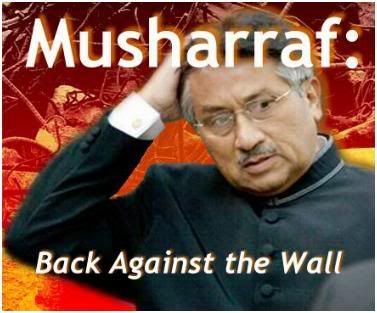
Gen. Pervez Musharraf, the dictator "President" of Pakistan (who created the position of President -- not in the Pakistan Constitution -- after
taking power in a military coup in 1999), is beginning to make some democratic and egalitarian noises -- for reasons, I am sure, of base self-interest. Simply stated, he is in trouble. He is losing control of his
increasingly independent-minded judiciary, he is
losing whatever support he has ever had of the citizens of Pakistan, and he is
losing the confidence of the West. At least he's got the military. But it may not be enough. He is being forced into a set of elections at the end of the year, and looking to two political rivals to shore up his power:
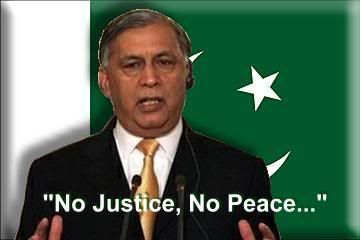
Nawaz Sharif and
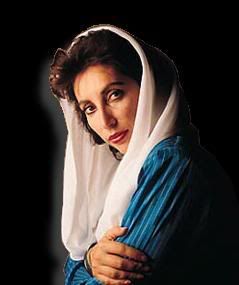
Benazir Bhutto.
Whatever his motivation (and I don't really care
why someone finally does the right thing), Musharraf is making guardedly centrist statements lately, and yesterday in Islamabad finally
stated the obvious and made the connection between terrorism and poverty. Speaking to an international land forces symposium on Common Security and the "Global War on Terrorism,"
President Musharraf urged the developed and industrialized States to help the Islamic countries in their socio-economic development as the extremism stems from poverty.
The President re-emphasized Pakistan's firm resolve to combat terrorism frontally and militarily but said that joint efforts were needed by the global community in achieving the objective of defeating the menace. He pointed out that extremism is a state of mind and could not be countered with force and needs a long-term strategy and total understanding of underlined causes which spawn the scourge.
Let me repeat and emphasize that last part:
Terrorism is a state of mind that cannot be countered with force and needs a long-term strategy and total understanding of its underlying causes. So, we're stepping back from global, unregulated, laissez faire, "free-market" capitalism, and --
FINALLY -- acknowledging that government has a larger role than merely smoothing the road for the creation of wealth. It also has the responsibility to see that the wealth is distributed equitably and justly. Well, at least Musharraf -- back against the wall -- is giving the idea lip service, even if he'd rather not. Why would he prefer not to say -- and do -- the right thing?
The President said that the poverty, illiteracy and misinterpretation of Islamic knowledge are the other inherent causes contributing to the rise of extremism.
Yes. Pakistan has only a
48% literacy rate -- 35% female literacy. Perhaps Musharraf will funnel some money into educating Pakistan's citizens? A quarter of Pakistan
lives below the poverty level -- the Pakistani poverty level.
Child labor is common there. Pakistan has a
per capita gross domestic product of $2,600. To put that into perspective,
Iraq -- in the midst of a bloody civil war, mounting insurgency, and daily chaos, has a
per capita GDP of $2,900.
For the life of me, I don't know why -- if we
had to invade someone and do some "regime change -- we invaded Iraq and not Pakistan.
(Musharraf) said two-pronged strategy on the one hand calls upon the Muslim States to shun extremism and go on the path of socio-economic development and on the other called upon the West, especially the United States , to help resolve outstanding disputes and assist in economic development of Islamic countries. (my emphasis)
Like it or not, folks, we are our brothers' keeper. From those to whom much is given, much is expected.
Musharraf joins a long list of global public figures who stepped out of the dark and acknowledged the reality of terrorism, including
Peter Munya, the
US Conference of Catholilc Bishops,
John Edwards,
Hugo Chavez,
Fernando Lugo,
Desmond Tutu,
Charles Dickens,
Muhammed Yunus, and
myself qho have been saying that you can't win a war on terror if you don't fight a war on poverty. For the record, the late Holy Father
Pope John Paul II believed this too.

 How much are we going to let Pervez Musharraf get away with? He has used the "fear of terrorism" to bolster his dictatorship, all the while justifying terrorism of which he approves and pampering terrorists in his own western frontiers.