2 Years After Invasion, Poll Data Mixed (washingtonpost.com)
See the full poll results at PollingReport.com.
One of the reasons I am optimistic about the human race (and about America's future) is that even though people can be fooled with lies and innuendo and propaganda, you cannot negate their essential goodness and their desire for truth. People don't want to do the wrong thing; they see a complex world and want to make the difficult choices that are for the best. That is why humans are so dependent on good information. When we get bad information, we will probably make bad decisions (hear that, Howie?). And we have been getting bad information in this country for a long time now.
So, there are pieces of this poll that are stunning. Consider this:
61% still believe Iraq provided direct aid to al Qa'ida.
56% still believe Iraq had WMDs that have judt not been found.
55% still believe that the Bush administration did not intentionally try to mislead the American people into war.
This is all, I suppose, understandable; as I said, I don't believe any creature that is essentially good wants to do the wrong thing, and so they will cling to beliefs that justify their decisions, even the in face of hard evidence that those beliefs have no foundation in reality.
On the plus side, reality seems to have sunk in at least a bit on the overall execution of the war. Take for example:
57% disapprove of the way Bush is handling the war.
57% don't believe that Bush has a clear plan for handling it.
53% think that, weighing the cost versus the benefits, the war was not worth fighting.
70% think the number of US casualties is unacceptable.
71% think the war has made the US position in the world weaker (41%) or has left it unchanged (30%).
54% think that the possibilities for democracy in the world as a result of this war is either less likely (9%) or unchanged (45%).
This flies in the face of the long-term goals of PNAC, which wants to project US force across the earth making the world safe for global capital. Americans don't want to do that; that's one of the reasons, I believe, that PNAC is mentioned so rarely (if EVER) in the mainstream media. Americans are idealistic and courageous enough never to hide from necessary warfare; but we're also decent enough not to want to fight indiscriminately. PNAC makes no such distinctions, and the American people, if they knew about PNAC, would be astonished and angry.
Which gets me to another point about this mainstream article. It mentions and quotes William Kristol as a supporter of the war against Iraq, identifying him as "editor and publisher of the conservative Weekly Standard," which is true. What it does not mention (and someone please explain to me why?) is that Kristol is also the Chairman of the PNAC, and one of the chief authors of the argument for WMDs in Iraq and for US military intervention. As such, he is one of the people most responsible for the war. Isn't that an important piece of information the American people might like to know?
Or that PNAC's Statement of Principles was developed by Donald Rumsfeld, Paul Wolfowitz, Dick Cheney, Lewis Libby, Jeb Bush, and others?

Showing posts sorted by relevance for query PNAC. Sort by date Show all posts
Showing posts sorted by relevance for query PNAC. Sort by date Show all posts
Wednesday, March 16, 2005


Friday, June 23, 2006
The end of the PNAC?
 The Project for A New American Century is "heading toward closing", said one undefined source close to the project.
The conservative think-tank claims members such as Vice President Dick Cheney, Governor Jeb Bush, radio host and former "drug czar" William J. Bennett, Scooter Libby, president of the world bank Paul Wolfowitz and Dan Quayle...and Don Rumsfeld.
The nine-year-old group founded by William Kristol will be closing its doors because of a sense of "goal accomplished" among its members.
Sounds strangely familiar to something our president said a few years ago.
The PNAC, if you don't know, has pretty much dominated the Bush administration's foreign policy for the past 6 years and championed a plan to oust Saddam Hussein long before 9/11.
I guess the new American century is finally here.
Monday, July 18, 2005
Why Does the Right Hate America? Part III
Large Volume of F.B.I. Files Alarms U.S. Activist Groups - New York Times
(Parts I and II can be read here and here.)
The Bush administration is undertaking another incredible assault of American values. The specific values are rights guaranteed in the first ten amendments to the US Constitution, the Bill of Rights. Specifically, the administration is violating the following amendments with impunity:
BULLSHIT.
No laws can override Americans's Constitutionally guaranteed rights enshrined in the US Constitution. That's why the Bill of Rights is there. That's why these ten amendments were added to the Constitution. These rights cannot be voted away by a foolish majority (no matter how big or how small). Period. They are our sacred rights as Americans. They represent authentic American values. They put limitations on Government, especially on lying, empire-building administrators of Executive power. That's why the right hates the Bill of Rights.
That's why the right hates America.
(Parts I and II can be read here and here.)
The Bush administration is undertaking another incredible assault of American values. The specific values are rights guaranteed in the first ten amendments to the US Constitution, the Bill of Rights. Specifically, the administration is violating the following amendments with impunity:
1. Congress shall make no law ... abridging the freedom of speech, or of the press; or the right of the people peaceably to assemble, and to petition the Government for a redress of grievances.So, where are these violations taking place?
4. The right of the people to be secure in their persons, houses, papers, and effects, against unreasonable searches and seizures, shall not be violated, and no Warrants shall issue, but upon probable cause, supported by Oath or affirmation, and particularly describing the place to be searched, and the persons or things to be seized.
9. The enumeration in the Constitution, of certain rights, shall not be construed to deny or disparage others retained by the people.
The F.B.I. has in its files 1,173 pages of internal documents on the American Civil Liberties Union, the leading critic of the Bush administration's antiterrorism policies, and 2,383 pages on Greenpeace, an environmental group that has led acts of civil disobedience in protest over the administration's policies, the Justice Department disclosed in a court filing this month in a federal court in Washington.Look, Howie, Americans have the right to protest. In some cases, where opposition to war is motivated by religious belief, they have a moral obligation to protest. Protesters engaged in unlawful civil disobedience know what they're doing, and know the consequences. Americans have the right to speak out against immoral and inhumane policies, to organize against them, and to engage in protest. To engage in domestic espionage against Americans who believe, for instance, that the Bush administration knowingly and willfully fabricated false "evidence" to create a rationale for an invasion of Iraq--if true, a blatantly political and illegal act--is to politicize the Constitution, reserving its protections for only those sympathetic to the Bush administration's (and the PNAC's) global political and economic goals. It's unconstitutional at best and immoral at worst.
"I'm still somewhat shocked by the size of the file on us," said Anthony D. Romero, executive director of the A.C.L.U. "Why would the F.B.I. collect almost 1,200 pages on a civil rights organization engaged in lawful activity? What justification could there be, other than political surveillance of lawful First Amendment activities?"Like the Nixon administration before it (and Nixon was a martyred hero to people like Cheney, Rumsfeld, and the PNAC crew), the Bush administration is creating a political police force of the CIA and the FBI, undermining the Constitution and endangering the liberties of all Americans. Espionage is nothing less than illegal search of private behavior and illegal seizure of private thought, and--without due process of the law--subversive of the fourth amendment.
Protest groups charge that F.B.I. counterterrorism officials have used their expanded powers since the Sept. 11 attacks to blur the line between legitimate civil disobedience and violent or terrorist activity in what they liken to F.B.I. political surveillance of the 1960's. The debate became particularly heated during protests over the war in Iraq and the run-up to the Republican National Convention in New York City last year, with the disclosures that the F.B.I. had collected extensive information on plans for protests.Many on the right (you listening, Howie?) will parrot once again the mindless mantra of "After 9/11 everything changed," and "It's a different and dangerous world and we can no longer cling to business as usual." The President has to have the power to fight terrorism. The President has certain powers enumerated in the War Powers Act and the USA Patriot Act which provide a legal basis for surveillance of "subversive" organizations.
BULLSHIT.
No laws can override Americans's Constitutionally guaranteed rights enshrined in the US Constitution. That's why the Bill of Rights is there. That's why these ten amendments were added to the Constitution. These rights cannot be voted away by a foolish majority (no matter how big or how small). Period. They are our sacred rights as Americans. They represent authentic American values. They put limitations on Government, especially on lying, empire-building administrators of Executive power. That's why the right hates the Bill of Rights.
That's why the right hates America.
Sunday, February 27, 2005
Telegraph (UK) : Powell 'Pushed Out' by Bush for Seeking to Rein in Israel
Telegraph News Powell 'pushed out' by Bush for seeking to rein in Israel
NOTE: It really piqued my curiosity that this story was published today, 2/27/05, and "filed" 11/21/04. I have written the editors of the Telegraph for an explanation. If I actually get an explanation, I'll update this post.
When Colin Powell resigned last November, we ruminated on the meaning of his departure. For all his military experience, for all his "good soldiering," for all his team playing, he was never a part of this team. A career soldier who helped whitewash the atrocities of My Lai, he was never extreme enough to please extremist ideologs of the PNAC.
Now comes this article (strangely enough, filed on November 21, 2004 but published today--what did the editors hold it for?) that says the straw that broke the PNACamel's back was Powell's wish to put pressure on Ariel Sharon to moderate his stand in the Palestinian conflict. It stilll sounds to me, though, like Powell's greatest sin was a penchant to try to use his head before pulling out his guns.
"Vice-president Dick Cheney and his fellow hardliner, John Bolton, an under-secretary of state to Mr Powell, are both understood to have lobbied Mr Bush to replace him.
"They wanted to make Iran's alleged nuclear bomb aspirations and support for Islamic terror groups the foreign policy priority for the new administration and believed that Mr Powell would back away from a confrontational approach."
Wednesday, November 17, 2004
After Colin Powell
Colin Powell is gone, which was not unexpected, and in itself is not a tragedy.
Perceived as moderate in the Bizarroland parallel universe we call the Bush administration, Powell was certainly a good soldier (his “investigation” into the My Lai massacres attests to this) and a pragmatist. His prosecution of the first Gulf War, and his articulation of the Powell Doctrine (the principle that forces should only be deployed when national interest, commitment, and support have been established) are also testimony more to his pragmatism than to his moderation. And pragmatism, on the whole, is not an entirely bad thing, especially within the context of this extremist, ideologically rigid administration. This pragmatism, at least, balanced the hawkish imperial mindsets of PNAC pals Rumsfeld, Wolfowitz, and Perle. But this balance has been perceived within the administration more as opposition, and perhaps Powell's greatest contribution to Bush’s presidency has been his reputation as “war hero” and his popularity among the American people.
Many people looked at Powell’s appointment as Secretary of State as a symbol of, and commitment to, moderation in the first Bush administration. But many others claimed that Powell had “sold his soul” in accepting it. If Powell’s “Faustian bargain” wasn’t evident enough in his near daily friction with neo-con empire builders, it certainly became obvious in the buildup to the US invasion of Iraq.
Before September 11, 2001 “changed everything,” Powell maintained that the policy of containment forced on Saddam Hussein under UN sanctions had worked, and continued working. He was initially opposed (as was the case in the first Gulf War) to an invasion of Iraq and the forcible overthrow of Saddam, wishing instead to continue a policy of containment. At a news conference in Cairo on February 24, 2001, Powell stated flatly
“…frankly they [sanctions] have worked. He has not developed any significant capability with respect to weapons of mass destruction. He is unable to project conventional power against his neighbors. So in effect, our policies have strengthened the security of the neighbors of Iraq, and these are policies that we are going to keep in place, but we are always willing to review them to make sure that they are being carried out in a way that does not affect the Iraqi people but does affect the Iraqi regime's ambitions and the ability to acquire weapons of mass destruction…”
He counseled Bush against invasion, invoking the so-called “Pottery Barn rule” (you break it, you own it). In Plan of Attack, Bob Woodward quotes Powell telling the President, "You are going to be the proud owner of 25 million people. You will own all their hopes, aspirations and problems. You'll own it all."
But the PNAC ideologues advising Bush administration would not budge, and “good soldier” Powell agreed to sell the idea of invasion to the world. Powell sought—unilaterally?—the involvement of the international community in the invasion, even as neo-cons fought for a unilateral approach. It was within this context that Powell addressed the United Nations on February 5, 2003 to argue in favor of a multinational coalition to overthrow Saddam.
But the evidence provided by the administration was scant, spotty, questionable, and ultimately false. And Colin Powell knew it. A US News & World Report article described an angry Powell, in a rehearsal of his presentation to the United Nations, taking the intelligence documents that constituted the case against Saddam and throwing them in the air, yelling “I’m not reading this. This is Bullshit!” And the world community knew, too, that it was just that and rejected the arguments.
At this point, Powell was all but finished as Secretary of State, so his resignation now comes as no surprise. The good soldier did his job and continued in his post. Many have wondered why Powell didn’t quit when asked to do something that apparently compromised his principles and his integrity. But Powell is and always has been the consummate “good soldier” and it is in the sometimes antagonistic relationship between loyalty and integrity that Powell’s Faustian bargain becomes so tragically clear.
Colin Powell is gone, which was not unexpected, and in itself is not a tragedy. The tragedy, when it presents itself, lies in what follows his exit. The United States, under this administration, continues its perilous move to the right. And the hard-liner who appeared moderate, the military man forced into submission by civilian hawks, will soon be forgotten, written off as a liability by the Project for a New American Century. In 1995, speaking of the decision not to pursue Saddam in an all-out invasion of Baghdad, Powell said
“Even if Hussein had waited for us to enter Baghdad, and even if we had been able to capture him, what purpose would it have served? And would serving that purpose have been worth the many more casualties that would have occurred? Would it have been worth the inevitable follow-up: major occupation forces in Iraq for years to come and a very expensive and complex American proconsulship in Baghdad? Fortunately for America, reasonable people at the time thought not. They still do.”
Are there any reasonable people left in America?
Wednesday, November 03, 2004
An e-mail to a right-wing Republican friend in NY
"...Now, Bush better read the pole numbers, realize it was again close, and he better reach across the isle, and get working on the economy, healthcare and the deficit." --Howie
Howie,
It is America who had better start reading.
It is a colossal act of arrogance to ignore reality and act on wishes, illusions, and myths. George W. Bush has made the world a far more dangerous place to live, and Americans don't see it. George W. Bush has recruited thousands and thousands of new martyrs for Jihad, and Americans don't see it. George W. Bush has weakened American civil liberties in the name of security and has given us neither, and Americans don't see it. But the rest of the world sees it. Someone is right here, and someone is wrong. Both points of view cannot be true.
The Department of Peace and Conflict Research at Uppsala University in Sweden reports that on average 9 minor armed conflicts (where the number of deaths does not exceed 1000 during the course of the conflict), 12 intermediate armed conflicts (where the number of deaths exceeds 1000, but is fewer than 1000 in any given year), and 13 wars (with more than 1000 deaths a year) go on at all times somewhere in the world. In the year 2000, war took the lives of 168,000 Africans, 65,000 Asians, 39,000 "middle-easterners," 37,000 Europeans, and 2,000 Central and South Americans. At the same time, American arms manufacturers profit from this death and destruction. Forty of the top one hundred arms-producing companies in the world are American companies with profits totaling $664 billion dollars in 1999. Over $93 billion of that profit comes from the manufacture and sale of weapons, more than the profit of the other 60 companies combined (US$64 billion).
Meanwhile, those in the less technologically developed world who are not dying in warfare are likely to be dying of disease or starvation. While the life expectancy of the average American was about 75 years in 2001, it was 65 for the Indonesian, 64 for the Russian, 45 for the Afghan, 39 for the Zambian, and 38 for the Rwandan and the Mozambiquan. While an American baby has 99.4% of survival after birth, the infant mortality rate is 2% for the Russian, 10% for the Ethiopian, almost 15% for the Afghan, and nearly 20% for the Angolan.
And while much of the "third world" believes that we care little for their welfare, many more question our motivations even less kindly. They believe we are more interested in exploiting their natural resources for our benefit, and exploiting them for their cheap labor.
Among the violations of the fair labor conventions of the International Labor Organization between 1996 and 2000, were many committed on behalf of American companies. Some examples:
· Factories in the Northern Mariana Islands (a US Commonwealth) that produce clothing for Abercrombie & Fitch, Cutter & Buck, Donna Karan, The GAP, J. Crew, Levi Strauss, Liz Claiborne, Nordstrom, Ralph Lauren Polo, Target, Dress Barn, and Tommy Hilfiger demand contracts of their workers which: waive basic human rights including the right to join a union; demand 12-hour workdays seven days-a-week; subject workers to "lockdowns" in the factory;
· Factories in China producing clothing and shoes for Adidas, Disney, Fila, Nike, Ralph Lauren, and Reebok employ forced labor in prison camps; demand of their employees 12-16 hour workdays, seven days-a-week; employ child labor; demand forced overtime; and Chinese workers for Nestle have been subjected to electric shock to maintain productivity.
· Factories in Indonesia manufacturing clothing and shoes for Adidas, the GAP, and Nike subject workers to forced overtime at a poverty wage.
· Factories in El Salvador producing clothing and shoes for Adidas, Ann Taylor, the GAP, Liz Claiborne and Nike pay their female employees about US$30/week for a 60-80 hour week; subject their female workers to forced pregnancy tests; fire their female workers if they become pregnant; and force some employees to work overtime without pay, up to 11 hours a day.
· Factories in Haiti producing clothing and toys for the Walt Disney Company pay their workers an average of US$2.40 per day, and charge them for transportation ($.66/day), breakfast (cornmeal and fruit juice--$.53/day), and lunch (rice and beans--$.66/day).
· Factories in Russia producing clothing for the GAP pay their employees US$.11/hour.
If terrorism is evil-and it is-this is terror's recruiting station.
But, we're told, what they really hate about America is "our freedom."
Americans know nothing of these things, all in the public record, because our "liberal" media are giving us not what we need to know, but what we want to know. This is the "free-market" approach to journalism.
Americans know nothing about the Project for a New American Century, even though they have their own website, and all their position papers are public record. Have YOU read any of their stuff?
Howie, I realize and appreciate why you're saying this. You're trying (very sincerely, I'm sure) to be conciliatory and reassuring. You're very comfortable with the results of this election, and you'd like me to be too. But that's not going to happen.
You think I'm a pain in the ass (I am), you think I'm a crank (I am), you think I'm "holier-than-thou" (you're wrong about that--again, what I'm looking for in a politician is the exact opposite of certainty, the exact opposite of this GOP, the exact opposite of PNAC), but you seem to think, I think, that I lack conviction, or that--like other Americans--I look at all of this as a game or a sporting event where, well, this time my team wins, and that time your team wins. Or you think that I think "winning" is important at all. I don't.
You talked about the "global society." Yet this administration flouts international opinion. It flouts human standards of decency in its economic policies, in its energy policies, in its environmental policies, and--worst of all--in its foreign policies. And in flouting these things, we turn our backs on the very values that defines America, at least in the past. F**k the rest of the world? Yeah, we can do that. But not for long. Because it IS a global society that is evolving. But it's not a "global society" the PNAC is interested in, it's a global economy.
The global society is becoming a reality. How we approach that reality will determine whether democracy survives, not just in the United States, but in the world.
Monday, September 15, 2008
An E-Mail Exchange With Howie, My (Far) Right-Wing Friend in NY: Is There, or Is There Not, a "Bush Doctrine?"
Howie: Basically, the term "Bush Doctrine" was coined by Charles Krauthammer, and I sent you his article that "suggested that the Bush administration policies of unilaterally withdrawing from the ABM treaty and rejecting the Kyoto protocol, together with others, amounted to a radical change in foreign policy that should be called the Bush doctrine."
Me: Howie, you're killing me with this. There are so many more important things I ought to be doing with my time than trying to persuade you that a pit-bull is not a pig and that a horse is not a house and that fantasy is not reality. It is, I believe, a powerful testimony of my unfailing love for you that I go to all this trouble. I only wish you had any respect for me -- and for yourself -- and took the world more seriously.
Me: Howie, you're killing me with this. There are so many more important things I ought to be doing with my time than trying to persuade you that a pit-bull is not a pig and that a horse is not a house and that fantasy is not reality. It is, I believe, a powerful testimony of my unfailing love for you that I go to all this trouble. I only wish you had any respect for me -- and for yourself -- and took the world more seriously.
I did a Lexis-Nexis search (it is a subscription database of, among other things, US and world newspapers, newsmagazines, and radio and television news transcripts which I have access to through Roosevelt's library) of the phrase "Bush Doctrine" for all the time between June 2002 and August 15, 2008. In other words, it does NOT search anything AFTER the Palin interview. I got over 1000 results. Please read them carefully. Here's my disclaimer, though: I'm only copying the essential parts of each story, where the term "Bush Doctrine" is used specifically. And, since this is a subscription service, I can't give you any hyperlinks. I urge you to go to a library and get a copy of each if you want to read the whole article.
Here's the very first one, from the Sydney (Australia) Morning Herald:
- Kill first, ask questions later
BYLINE: Robert Manne. Robert Manne is associate professor of politics at La Trobe University.
SECTION: NEWS AND FEATURES; Opinion; Pg. 13 LENGTH: 966 words
September 30, 2002
Monday Late Edition
The black holes in Bush's logic might suck us all in.TEN days ago, George Bush handed to the Congress a document of fundamental importance, outlining a new military doctrine for the United States.
The new doctrine argues that in the 10 years following the Soviet collapse, the US failed to grasp the nature of the threats posed by the post-Cold War world. With the terrible events of September 11, America awoke.
At first, the US characterised the new enemy it faced as "terrorism". Later, it refined the idea of the new enemy to "terrorism with a global range", a euphemism for the
kind of terrorism with the capacity to inflict harm on the civilian populations in America or the West.
Since the shock of September 11, the new enemy has expanded to include what have been called "rogue states". In the Bush doctrine, a rogue state is a regime which brutalises its own people, seeks to acquire weapons of mass destruction and expresses hatred for the US...We arrive here at the heart of the new Bush military doctrine. The US, it is claimed, presently faces the prospect of
attack either from one of the rogue states or from a terrorist group supplied by
them with weapons of mass destruction. Before this kind of threat, Cold War
ideas about deterrence and containment are obsolete. The only rational military strategy is the "pre-emptive strike".
Here's one from the Straits Times (Singapore) from October of 2002 (first two paragraphs):
- Dubya's dangerous and divisive doctrine
October 16, 2002 Wednesday
AMITAV ACHARYATHE new American strategic doctrine of pre-emptive strikes, enunciated a year after Sept 11, provokes more discord internationally than it catalyses accord domestically.
Past presidential doctrines helped American leaders mobilise domestic support and organise international coalitions. The Bush Doctrine is the most divisive post-war pronouncement.
From the Washington Post, October 2003 (I'm copying the entire article, as it directly references the Bush Doctrine several times, and even quotes Richard Perle -- one of the neo-cons who created it through his work at PNAC -- directly referring to the Bush Doctrine as preemptive first strike):
December 21, 2003 Sunday Final Edition
BYLINE: Dana Milbank, Washington Post Staff Writer
SECTION: A Section; A26LENGTH: 1041 words
It has been a week of sweet vindication for those who promulgated what they call the Bush Doctrine.
Beginning with the capture of Saddam Hussein a week ago and ending Friday with an agreement by Libya's Moammar Gaddafi to surrender his unconventional weapons, one after another international problem has eased.
On Tuesday, the leaders of France and Germany set aside their long-standing opposition to the war in Iraq and agreed to forgive an unspecified amount of that country's debt. On Thursday, Iran signed an agreement allowing surprise inspections of its nuclear facilities after European governments applied intense pressure on the U.S. foe. On Friday, Libya agreed to disarm under the watch of international inspectors, just as administration officials were learning that Syria had seized $23.5
million believed to be for al Qaeda.To foreign policy hard-liners inside and outside the administration, the gestures by Libya, Iran and Syria, and the softening by France and Germany, all have the same cause: a show of American might.
Those who developed the Bush Doctrine -- a policy of taking preemptive, unprovoked action against emerging threats -- predicted that an impressive U.S. victory in Iraq would intimidate allies and foes alike, making them yield to U.S. interests in other areas.
Though that notion floundered with the occupation in Iraq, the capture of Hussein may have served as the decisive blow needed to make others respect U.S. wishes, they say. "It's always been at the heart of the Bush Doctrine that a more robust policy would permit us to elicit greater cooperation from adversaries than we'd had in the past when we acquiesced," said Richard Perle, an influential adviser to the
administration. "With the capture of Saddam, the sense that momentum may be with us is very important."Perle had provoked much criticism for saying a successful U.S. invasion of Iraq would signal to other foes that "you're next." But he said the actions by Libya and Iran prove that the threat alone was sufficient to produce action. "Gaddafi surely had to take more seriously that we would not allow him to get away with the programs he was embarked," he said.
Perle and the other "neo-conservative" hawks whose views dominate the Bush administration know better than to claim victory. Gaddafi or the Iranians may still cheat despite admitting inspectors. And other potential foes, notably North Korea and China, have shown little susceptibility to the threat implicit in the Bush Doctrine.
Still, Perle allowed, "it's nice to have a good week every once in a while."
Bush's domestic adversaries have had some trouble responding to the administration's diplomatic successes. Sen. John F. Kerry (D-Mass.), a presidential aspirant, portrayed the success with Libya as an exception to the Bush Doctrine. "Ironically, this significant advance represents a complete U-turn in the Bush administration's overall foreign policy," he said in a statement Saturday. "An administration that scorns multilateralism and boasts about a rigid doctrine of military preemption has almost in spite of itself demonstrated the enormous potential for improving our national security through diplomacy."
But Bush's supporters say it is precisely his willingness to go it alone and take preemptive action that has encouraged other countries to seek diplomatic solutions before the United States launches a military attack. The Libya and Iran concessions "show the peripheral benefit of preemption," said Kenneth Adelman, a Reagan administration arms control official who now serves on a Pentagon advisory panel. "Most of all it scares the bejesus out of rogue dictators." As for stubborn allies such as Jacques Chirac and Gerhard Schroeder, "they pay more attention when there's a forceful U.S. policy," Adelman said.
It is unlikely, of course, that France or Germany would acknowledge that they are reacting to U.S. strength. Yet it is noteworthy that they were conciliatory on the issue of Iraqi debt forgiveness after Hussein was captured -- even though they were complaining bitterly just a week before about a Bush plan to exclude them from U.S.-funded Iraq reconstruction projects.
And it is inarguable that Germany and France have taken a more active role in winning Iranian compliance with weapons inspections since the United States invaded Iraq. The foreign ministers of Germany, France and Britain visited Iran in
October, overcoming Iran's longtime resistance to signing a monitoring agreement.
"The Europeans never would have taken these steps [in Iran] without Bush taking the steps he took in Iraq," said Gary Schmitt, who directs the hard-line Project for the New American Century. "The Europeans don't want us to do another Iraq there, so they're rushing in to get a deal. Bush gets an immense amount of credit for laying out what the agenda is and making others step up to the plate."Bush still has some inconsistencies to work out with his doctrine. Earlier this month, he drew rebukes from conservatives for undermining democratic Taiwan to win favor with totalitarian China. And, as Bush's domestic opponents point out, he has been contradictory in his views of international organizations. Rep. Edward J. Markey (D-Mass.) said the administration's support for International Atomic Energy Agency inspectors in Libya and Iran "is difficult to reconcile with the administration's previous ridicule of IAEA inspectors in Iraq."
But such complaints, at least for now, have been overshadowed by the results achieved with Iran and Libya. That was the clear message Bush delivered in his unusual appearance late Friday in the White House briefing room. Mentioning the fate of Hussein, Bush said, "These actions by the United States and our allies have sent an unmistakable message to regimes that seek or possess weapons of mass destruction."
If Bush was oblique, a senior aide who briefed reporters after the president's statement, was quicker to take credit. "The outcome today is a response [to] the policies that we have pursued," he said. The official said the secret discussions with Libya began in March -- when the invasion of Iraq started. "I can't imagine that Iraq went unnoticed by the Libyan leadership," the aide said.
And -- WOW!!! -- I actually found a reference to the phrase "Bush Doctrine" that links it directly to the White House and the Bush administration, and dates it as far back as October 2001.
USA TODAY
October 9, 2001, Tuesday, FIRST EDITION
BYLINE: Laurence McQuillanSECTION: NEWS; Pg. 8A LENGTH: 526 words DATELINE: WASHINGTONWASHINGTON -- White House officials gave a name Monday to the rules of engagement driving the U.S. war on terrorism -- the "Bush Doctrine." The policy makes any nation or group that tolerates terrorists a potential target.
From the Toronto (Canada) Globe and Mail:
- Monroe, Truman and Bush?; U.S. leader aims to become only the third; chief to lay a foreign-policy cornerstone
The Globe and Mail (Canada)
October 20, 2001 Saturday
BYLINE: JOHN IBBITSON SECTION: INTERNATIONAL NEWS; The War on Terror: THE BATTLE OF IDEAS; Pg. A10 LENGTH: 751 wordsDATELINE: WASHINGTON
There was the Monroe Doctrine. There was the Truman Doctrine. Now, there is the Bush Doctrine.
In his Sept. 20 speech to Congress, U.S. President George W. Bush declared that all nations must either join the United States in combatting terrorism, or be its enemy. He said the government would act against any individual, organization or state "of global reach" that supports terrorism.
In the weeks since, Mr. Bush has referred to "the doctrine I spelled out to the American people." Vice-President Dick Cheney invoked "the Bush Doctrine" in a rousing call to arms Thursday evening.
Coalition forces are attacking Afghanistan in the air and now on the ground in the name of the Bush Doctrine. A growing chorus of politicians demands that the United States attack Iraq in the name of the Bush Doctrine.
From the Boston Globe and the Australian Financial Review on the global political implications of the Bush Doctrine, from October and December of 2001, respectively:
- A DOUBLE STANDARD IN WAR ON TERRORISM?
The Boston Globe
October 24, 2001, Wednesday ,THIRD EDITION
BYLINE: By Scot Lehigh, Globe Staff SECTION: OP-ED; Pg. D7 LENGTH: 699 wordsIF YOU WISH to converse with me, Voltaire said, define your terms.
In speaking to the world, President Bush needs to do just that, for his zero-tolerance antiterrorism doctrine is one that both friends and rivals clearly hope to appropriate for their own purposes.
Consider our newfound comrade Vladimir Putin, the Russian president. Noting that the Kremlin considers the Chechen separatists to be terrorists with ties to Osama bin Laden, he has declared that the United States and Russia share a common foe.
Or Prime Minister Ariel Sharon of Israel, who called Palestinian leader Yasser Arafat Israel's Osama bin Laden. Why, with America drawing a line in the sand against terrorism, should Israel be pressured to negotiate with a man who has sponsored and encouraged terrorists, he asked?
A bit less vocal was India, which faces attacks by Islamic militants hoping to pry all of disputed Kashmir away. "If the US can strike Afghanistan after the Sept. 11 attacks ... why can't we take similar action against terrorists harbored by Pakistan?" wondered Farooq Abdullah, Kashmir's chief minister. Orwellian China would just as clearly like the world to view Tibet through the lens of the Bush doctrine, while Malaysia has used it to justify a suppression of peaceful dissent. And that's just for starters.
- Bush Doctrine suddenly crystallises
The Australian Financial Review
December 10, 2001 Monday
BYLINE: Peter Hartcher SECTION: Pg. 1/11. LENGTH: 99 wordsThe US President, George W Bush, has won huge support for his stand against terrorism. Bush has established a doctrine that holds all countries that harbourterrorists as being accountable to the US. Bush has declared that for every country that support terrorists there will be a "day of reckoning". Governments around the world have received a warning from what has happened in Afghanistan.
The war in Afghanistan having almost reached a conclusion, the US Government must decide in which country its forces will seek terrorists next. An attack on Saddam Hussein's regime in Iraq appears imminent.
Howie (and all my other right wing friends out there), I know you. I don't expect any of this to change your (for lack of a better word) "mind." But you are wrong about this, you are being deceived by post-game spin, and nothing you say or do or believe can EVER change history. There is a Bush Doctrine, it was promulgated by the White House, it has been debated and discussed in terms of its implications for foreign policy and for global politics, and neither Sarah Palin nor you seems ever to have heard of it.
The GOP and right-wing spinmeisters might indeed be successful persuading those American people who choose ignorance over information, and who choose to be led around on a leash by the right-wing media that there are "several Bush Doctrines," but history has already recognized one.
And that's really all there is to it. A century from now people will be studying the Bush Doctrine, and what they'll be studying is this dangerous principle of the preemptive first strike.
There's nothing you can do to change that.
Wednesday, May 16, 2007
Fight Against Terrorism by Fighting Poverty
The real war on terror isn't going very well yet, but there is some progress being made.
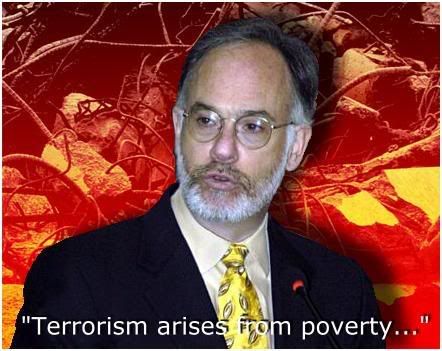
Recently, Terry Davis, Secretary General of the Council of Europe, wrote an article in the Romanian newspaper Jurnalul National cautioning that the current anti-terror tack of the Western developed nations (led by the US and UK) is, at best, imcomplete if it ignores the root causes of terrorism. Now, US Ambassador to Turkey Ross L. Wilson has said the same thing, joining a growing chorus of world leaders and opinion makers, including Philippine Chief Justice Reynato Puno, Peter Munya, the US Conference of Catholilc Bishops, John Edwards, Hugo Chavez, Fernando Lugo, Desmond Tutu, Charles Dickens, Muhammed Yunus, myself, and even Pakistan dictator Gen. Pervez Musharraf . For the record, the late Holy Father Pope John Paul II believed this too. That sounds like a pretty good bunch of people to stack up against the likes of Feith, Wolfowitz, Cheney, Rumsfeld, Kristol, and the rest of the PNAC cabal that persists in Washington. I'll take John Paul II over George W. Bush any day.
Wilson told a conference conducted by the George C. Marshall European Center for Security Studies and the Center of Excellence-Defense Against Terrorism in cooperation with the NATO-Russia Council that
Most people would find it hard to argue against the idea that terrorist violence arises, sociologically speaking, out of poverty, despair, hopelessness and resentment.It's amazing how many people don't find it all hard to argue this point. To some, terrorism has nothing to do with poverty, it has to do with an evil ideology that seeks nothing but political hegemony. This thinking links up comfortably with the Bush administration's "good vs evil" approach to foreign policy. Besides, they often point out, so many of these terrorists went to school and had jobs...
It is true that terrorist leaders seem more often than not to come from middle-class backgrounds. But terrorists do not just spring forth from Medusa's head, and effective government policy will seldom just involve cutting off terrorism's tentacles. The causes must be considered, and constructive policies must be devised to draw people away from the dead ends of violence and despair.Yes. Are you listening?
Wednesday, February 01, 2006
What Bush Didn't Say : If You Want Peace, Work for Justice
Some thoughts on last night's state of the union address:
Tonight the state of our Union is strong, and together we will make it stronger.
Perhaps it is. After all, we've been one of only two economic and military superpowers in the world for over a half century, and the only superpower for the last twenty years. The state of the union ought to be strong. The question is, is the state of our union as strong right now as it ought to be. Or, to paraphrase Ronald Reagan, are we better off now than we were five years ago?
The only way to protect our people, the only way to secure the peace, the only way to control our destiny is by our leadership. So the United States of America will continue to lead.
The question is, where are we being led? Where are we leading others to? Yes, leadership in the world is good. Dictatorship is not. Leadership that seeks out economic justice and human rights is good. Leadership that favors elite groups over the powerless, that favors the interests of money over the interests of people is not. Leading by the example of 217 years of democratic values is a good thing. Abandoning democratic values -- American values -- at home and attempting to impose something we call "democracy" on others is not.
Dictatorships shelter terrorists, and feed resentment and radicalism, and seek weapons of mass destruction. Democracies replace resentment with hope, respect the rights of their citizens and their neighbors, and join the fight against terror.
Well. Where in the world is Luis Posada Carriles? And telling Americans, "If you are not a terrorist, you have nothing to fear from domestic wiretaps" is hardly respecting the rights of citizens.
Terrorists like bin Laden are serious about mass murder and all of us must take their declared intentions seriously. They seek to impose a heartless system of totalitarian control throughout the Middle East and arm themselves with weapons of mass murder. Their aim is to seize power in Iraq and use it as a safe haven to launch attacks against America and the world.
The question is, why is Osama bin Laden still a free man? Why did we never commit more than thirteen thousand troops to Afghanistan? Why did we invade a country that had no links, to al Qa'ida, no weapons of mass destruction, and nothing to do with terror attacks on US soil? What do we do now about terror and what do we do about terrorists? We have created the Iraq that is a haven, breeding ground, and training camp for terrorists. As hateful as Saddam Hussein was, he kept Iraq free of radical Islamic terror.
It is here that Bush might have -- and should have -- echoed the words of the late Roman Catholic Pontiff, Pope Paul VI : If you want peace, work for justice.
It is a rarely recognized demographic reality -- our mass mediated fixation on celebrity, sports, and pseudo-patriotism keeps us IN THE DARK about such things -- that much of what we consider the "third world," the under-developed areas of the earth, are overwhelmingly Islamic. North and Northeastern Africa. Western and southeastern Asia. Southeastern Europe. Indonesia, the Phillipines, Morocco, the Northern Marianas Islands (thank you, Messrs. Abramoff and DeLay) are places where sweatshops, poverty, and prostitution (forced or free) abound.
Bush and the PNAC ignore this inconvenient fact. They are NOT representative of the kind of leadership America is capable, and NEEDS.
Once again, we accept the call of history to deliver the oppressed and move this world toward peace.
I absolutely reject the notion that this administration is attempting, in any way, shape or form, to "deliver the oppressed." Deliverance from oppression will entail rejecting and overruling the arbitrary and irrational "invisible hand" of un-regulated, laissez faire, "free-market" capitalism, and ensuring that people -- here in the US and around the world -- are not exploited and hurt by a global consumerism. Just ask the late Roman Catholic Pontiff Pope John Paul II.
More on the address later.
Thursday, January 19, 2006
Purported Bin Laden Tape : New Attacks on US "Just a Matter of Time"
I've linked to al Jazeera's story on the bin Laden tape not because of any preference, but because, in the absence so far of any complete transcript on the web, al Jazeera included the most comprehensive coverage of bin Laden's message.
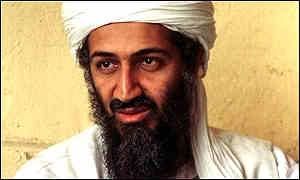
A couple of points need to be made. On the tape, the voice purported to be bin Laden's says:
Frightened and sobered by both the 9/11 attacks and the Bush administration's shameless exploitation of those attacks (Don't think so? Check this out. Has the memory faded so quickly?), most Americans forget that it was more than eight years between the first al Qa'ida attack on American soil (February 26, 1993 truck bomb at the World Trade Center) and the second (September 11, 2001). These people are not in a hurry.
I don't believe for a second that we have not been attacked because of the vigilance and efficiency of the Bush administration. We will be attacked again, no question in my mind. And we will be attacked at least in part because of the Bush administration's--and the PNAC's) lying and fumbling Iraqi policy.
Bin Laden said:
The Bush administration has responded to HRW, predictably, by charging that the group has a "political agenda" (yeah, they do, and it's in their name: HUMAN RIGHTS).
On March 13, 2002, Bush made the following remarks in a White House press conference:
I can't express strongly enough how really angry I am that bin Laden is still free and able to make the threats against the US that he is making. Why is this man free? Convince me that the strongest, most technologically developed country in the world cannot find and capture him. Convince me, Howie. Convince me that it has nothing to do with keeping Pervez Musharraf, a tyrant every bit as corrupt and brutal as Saddam Hussein, in power in Pakistan. Convince me that Osama bin Laden's apparently charmed life has no connection to his early ties, and perhaps continuing ties, to the CIA, as well as to Musharraf's spy agency, the ISI.
I just want to know why we "can't" capture bin Laden.
A couple of points need to be made. On the tape, the voice purported to be bin Laden's says:
The new operations of al-Qaida has not happened not because we could not penetrate the security measures. It is being prepared and you'll see it in your homeland very soon.The right has been pretty adamant that "there have been no new attacks on US soil since 9/11," meaning, of course, that we have been spared by surrendering some of our Constitutional rights, by surrendering, essentially, our American values. Dick Cheney has said more or less the same thing in his defense of the Patriot Act and illegal domestic spying.
Obviously no one can guarantee that we won't be hit again. But neither should anyone say that the relative safety of the last four years came as an accident. America has been protected not by luck, but by sensible policy decisions, by decisive action at home and abroad and by round-the-clock efforts on the part of people in law enforcement, intelligence, the military and homeland security.Or maybe not.
Frightened and sobered by both the 9/11 attacks and the Bush administration's shameless exploitation of those attacks (Don't think so? Check this out. Has the memory faded so quickly?), most Americans forget that it was more than eight years between the first al Qa'ida attack on American soil (February 26, 1993 truck bomb at the World Trade Center) and the second (September 11, 2001). These people are not in a hurry.
I don't believe for a second that we have not been attacked because of the vigilance and efficiency of the Bush administration. We will be attacked again, no question in my mind. And we will be attacked at least in part because of the Bush administration's--and the PNAC's) lying and fumbling Iraqi policy.
Bin Laden said:
The war in Iraq is raging and the operations in Afghanistan are increasing.I don't know how anyone can argue this point. A year ago, the CIA published a little-noted report outlining how Iraq, as a result of our invasion and occupation, had become a breeding ground and training camp for terrorists. I posted about it here. Last April, the US State Department published a report showing that global terrorism is on the rise. Human Rights Watch has made a similar point to these in its 2006 Annual Report. The rights group argues that abusive interrogation techniques (i.e., torture) actually weakens rather than aids the war on terror.
The Bush administration has responded to HRW, predictably, by charging that the group has a "political agenda" (yeah, they do, and it's in their name: HUMAN RIGHTS).
On March 13, 2002, Bush made the following remarks in a White House press conference:
Well, as I say, we haven't heard much from him. And I wouldn't necessarily say he's at the center of any command structure. And, again, I don't know where he is. I --I'll repeat what I said. I truly am not that concerned about him.Well, you've heard from him now, Mr. President. You've heard from every bit as clearly as you did in your August 6, 2001 Presidential daily briefing titled "Bin Laden Determined to Strike in US." You ignored him then. Will you ignore him now?
I can't express strongly enough how really angry I am that bin Laden is still free and able to make the threats against the US that he is making. Why is this man free? Convince me that the strongest, most technologically developed country in the world cannot find and capture him. Convince me, Howie. Convince me that it has nothing to do with keeping Pervez Musharraf, a tyrant every bit as corrupt and brutal as Saddam Hussein, in power in Pakistan. Convince me that Osama bin Laden's apparently charmed life has no connection to his early ties, and perhaps continuing ties, to the CIA, as well as to Musharraf's spy agency, the ISI.
I just want to know why we "can't" capture bin Laden.
Pentagon Worried About Chavez
An Update on the "New Axis of Evil"TM
From El Universal.com via Watching America, a Venezuelan op-ed piece that describes just how seriously the Pentagon is taking Hugo Chavez.
You heard it here first, folks. Over a year ago.
From El Universal.com via Watching America, a Venezuelan op-ed piece that describes just how seriously the Pentagon is taking Hugo Chavez.
...(The) Pentagon's position confirms information given out by Washington Post Military analyst William M. Arkin, that Venezuela looms as a "potential military threat" in a new "axis of evil" made up of Iran, China, Syria, and North Korea.The reference is to a piece by Arkin in the Washington Post last November.
In other words, 9/11 provided suitable cover for some of the policy initiatives of the Project for a New American Century (like an invasion and occupation of Iraq, and the use of a pre-emptive first strike), but the PNAC and the Bush administration (if that is not redundant) will not think twice about military intervention, even if the threat of terrorism is absent.The Pentagon has begun contingency planning for potential military conflict with Venezuela as part of a broad post-Iraq evaluation of strategic threats to the United States.
The planning has been precipitated by general and specific directives issued by Secretary of Defense Donald Rumsfeld and his civilian policy assistants.
...
Military sources ascribe Venezuela's emergence on a list of actual military threats as a reflection of an important post 9/11 war reality: The events themselves of September 11 provide justification -- and perceived need -- to take risks in thinking about unanticipated threats. "The Global War on Terror is rightfully our near-term focus, but we certainly don’t want to be caught flat-footed by a series of other possibilities," says one Defense Department planning document.
You heard it here first, folks. Over a year ago.
Saturday, January 14, 2006
NSA Spying on "Terrorist" Quakers
NSA used city police as trackers - baltimoresun.com
I'm starting to lose faith (but don't worry--I won't) that Howie and his right-wing ilk will ever look at the policies and actions of this Bush administration and their friends in the PNAC and acknowledge that the Constitution of the United States is held by them in utter contempt.
Here's a report that, since September 11, 2001, the NSA has been working with local police forces to spy on peace activists. In the case sited, those activists were members of American Friends Service Committee--the Quakers. The idea of Quakers being in league with terrorists is about as ridiculous and illogical and historically false as the idea that Saddam was ever in league with al Qa'ida (an idea, however, that Howie and, I'm sure, most of the right desperately clings to).
I'll say it again: if we abandon our rights, if we abandon the Constitution, we are no longer America.
Friday, December 16, 2005
The Election the US Media Are NOT Talking About
An update on the "New Axis of Evil"TM
Bolivia, a nation of only nine million people, is giving Washington (and the fine folks at PNAC) conniptions. They are getting ready to elect--democratically--their first President of indigenous Indian background. Sounds pretty democratic to me. Pretty egalitarian. The people are voting against a history of colonialism and North American influence. Kind of like Iraq. Who could find fault with this?
Well, the Bush administration for one. You'll notice they are not trumpeting the upcoming elections--which heavily favor former coca farmer and labor leader Evo Morales--as a "milestone" (although it is as much, if not more, of a milestone than yesterday's election in Iraq) in the history of democracy. in fact, they are doing everything they can to make it appear to be a symptom of dangerous chaos. The US State Department has sent our advisories that Sunday's election has created a "climate of potential violence."
Current Bolivian President Eduardo Rodriguez said yesterday that he "deplored" the insinuations that this particular election would somehow be marred by violence.
This is, of course, a CYA operation for the US State Department, a first step in delegitimizing the election should Morales win. Since Morales has a strong ally in Venezuelan President Hugo Chavez, since he opposes free trade agreements with the US, since he supported a bill in the Bolivian Senate that increased taxes on foreign-owned oil companies ten times and is likely to follow Chavez's lead in nationalizing the oil industry, we may need to have some "intelligence" that rationalizes an invasion someday.
Tuesday, December 06, 2005
Morales's Lead in Bolivian Presidential Campaign Strong
The prospect of "freedom on the march" and democracy at work in Bolivia gives the Bush administration and their PNAC bedfellows nightmares.
Evo Morales is an indigenous socialist former labor leader and Bolivian congressman who wants to nationalize the oil companies and legalize the growing of coca (although he wants to legalize it only for the manufacture of legal products, like teas and soft drinks), and who would cultivate strong ties with Fidel Castro's Cuba.
Anyone giving odds on an invasion timetable?
Tuesday, July 19, 2005
America : We Want a Democratic Congress!!!
Election 2006
A series of polls last week showed that Americans are leaning toward Democratic candidates in the 2006 Congressional elections.
Recent polls have indicated widespread disapproval of the GOP-dominated Congress's performance, and this undoubtedly contributes to Americans' desire for change.
As we've noted earlier, Americans see Congress as being "out of touch" with issues that concern most Americans. Abortion and Social Security are two of those issues, but Americans are also more broadly concerned with Government interference in personal, moral issues as exemplified in the Terri Schiavo case.
The GOP is way out of the mainstream. Contrary to its founding principles, contrary to its early history, contrary to the legacy of Abraham Lincoln, Theodore Roosevelt, and Dwight Eisenhower, it has become an elitist, extremist instrument of special-interest wealth and power (read: PNAC). The GOP IS the elite.
The GOP must go.
A series of polls last week showed that Americans are leaning toward Democratic candidates in the 2006 Congressional elections.
NBC News/Wall Street Journal Poll conducted by the polling organizations of Peter Hart (D) and Bill McInturff (R). July 8-11, 2005. N=1,009 adults nationwide.
"What is your preference for the outcome of the 2006 congressional elections: a Congress controlled by Republicans or a Congress controlled by Democrats?"
Controlled ByRepublicans 40%
Controlled ByDemocrats 45%
Unsure 15%
National Public Radio Poll conducted by Public Opinion Strategies (R) and Greenberg Quinlan Rosner Research (D). July 7-11, 2005. N=825 likely voters nationwide. MoE ± 3.5."I know it is far ahead, but thinking about next year's elections, if the election for U.S. Congress were held today, would you be voting for the Democratic candidate or the Republican candidate in your district where you live?"
Republican 40%
Democrat 47%
Other (vol.) 2%
Unsure 11%
Westhill Partners/Hotline Poll. July 7-10, 2005. N=800 registered voters nationwide. MoE ± 3.5.
"In your opinion, do you think the country would be better off if the Republicans controlled Congress or if the Democrats controlled Congress?"
Republicans 30%
Democrats 34%
Neither (vol.) 24%
Unsure 12%
"And, thinking about the next election for U.S. Congress, if the election for U.S. Congress were held today, would you be voting for the Democratic candidate or the Republican candidate in your district where you live?"
Republican 33%
Democrat 39%
Neither (vol.) 10%
Unsure 17%
Recent polls have indicated widespread disapproval of the GOP-dominated Congress's performance, and this undoubtedly contributes to Americans' desire for change.
Associated Press/Ipsos poll conducted by Ipsos-Public Affairs. July 11-13, 2005. N=1,000 adults nationwide. MoE ± 3.1.
"Overall, do you approve, disapprove or have mixed feelings about the way Congress is handling its job?" If "mixed feelings" or unsure: "If you had to choose, do you lean more toward approve or disapprove?"
Approve 35%
Disapprove 60%
MixedFeelings 4%
Unsure 1%
NBC News/Wall Street Journal Poll conducted by the polling organizations of Peter Hart (D) and Bill McInturff (R). July 8-11, 2005. N=1,009 adults nationwide. MoE ± 3.1."In general, do you approve or disapprove of the job that Congress is doing?"
Approve 28%
Disapprove 55%
Unsure 17%
As we've noted earlier, Americans see Congress as being "out of touch" with issues that concern most Americans. Abortion and Social Security are two of those issues, but Americans are also more broadly concerned with Government interference in personal, moral issues as exemplified in the Terri Schiavo case.
The GOP is way out of the mainstream. Contrary to its founding principles, contrary to its early history, contrary to the legacy of Abraham Lincoln, Theodore Roosevelt, and Dwight Eisenhower, it has become an elitist, extremist instrument of special-interest wealth and power (read: PNAC). The GOP IS the elite.
The GOP must go.
Thursday, June 23, 2005
Venezuela : Evidence of Assassination Plot Against Chavez
Venezuela's Interior Minister Says he has Evidence of Assassination Plot
Interior and Justice Minister Jesse Chacon says the Venezuelan government has evidence of a plot to assassinate President Hugo Chavez. Venezuelan intelligence agents say they believe Right-wing, anti-Chavez Venezuelans have met with Colombian Right-wing paramilitaries.
Just three weeks ago, two American soldiers were arrested for allegedly selling weapons to the United Self-Defense Forces of Colombia (AUC), a Right-wing paramilitary group who the US State Department has labeled a terrorist organization. While State Department spokesman Richard Boucher denied that the US was selling arms to an illegal organization, he would neither confirm nor deny whether the weapons were part of a $3.3 billion defense deal with Colombia.
Meanwhile, the Bush administration has been very supportive of a Colombian law granting immunity from prosecution to Right-wing terrorist groups.
Venezuela--and other left-of-center governments in Latin America--is a thorn in Bush's side, and in the side of the PNAC. General John Craddock, the head of the U.S. Southern Command, warned of the dangers of “radical populism” in Latin America and singled out Venezuela as “generating a destabilizing situation that represents a danger for the hemisphere.” On January 19, US Secretary of State Condoleeza Rice said of Chavez (failing to note the irony), "We are very concerned about a democratically elected leader who governs in an illiberal way."
Now, let me get this straight: Colombia is our ALLY in Latin America, and Uruguay, Brazil, Argentina, Venezuela, and other left-of-center social democracies constitute a "New Axis of Evil,"TM do I have that right?
There's something dreadfully wrong here.
Tuesday, June 21, 2005
Bolton Losing Ground in Senate; Bush Threatening Recess Appointment
Bolton fares even worse in second vote
This nomination should be considered DOA. It always should have been. It is not a matter of Democrats "winning" a political battle and Republicans "losing" one. Bolton is bad news, and should never have been nominated.
It's not a matter of "bad management style," either. It's the ideology. It's the tendency to put administration (read: PNAC) policy over truth. Ray McGovern notes:
ReidBlog describes a similar policy of politicizing intelligence with regard to Cuba:
Bolton's nomination will not be approved. It should be dropped. But Bush is now entertaining the idea of appointing Bolton while Congress is in recess.
This nomination should be considered DOA. It always should have been. It is not a matter of Democrats "winning" a political battle and Republicans "losing" one. Bolton is bad news, and should never have been nominated.
It's not a matter of "bad management style," either. It's the ideology. It's the tendency to put administration (read: PNAC) policy over truth. Ray McGovern notes:
...John Bolton played a key role in ordering that discredited intelligence be used to support the president's case for war, three months before the attack on Iraq.
ReidBlog describes a similar policy of politicizing intelligence with regard to Cuba:
The correspondence provided to the Senate committee also includes a Feb. 12 message sent to Mr. Bolton by Mr. Fleitz, who disparages what he calls the "already cleared (wimpy) language on Cuba" that Mr. (Christian C.) Westermann (the State Department's top expert on biological weapons who clashed sharply with Mr. Bolton over Cuba) had recommended be used by Mr. Bolton in his planned speech...(Bolton:) "I explained to Christian that it was a political judgment as to how to interpret this data, and the I.C. (intelligence community) should do as we asked and sanitize my language as long as sources and methods are not compromised."
Bolton's nomination will not be approved. It should be dropped. But Bush is now entertaining the idea of appointing Bolton while Congress is in recess.
Bush has the power to install Bolton during the Senate's upcoming break. The so-called recess appointment would only last through the next one-year session of Congress -- in Bolton's case until January 2007.
Tuesday, June 14, 2005
Chavez Blames Bolivian Crisis On Bush, Free Market
Chavez Blames Bolivian Crisis On Bush and the Free Market
Chavez is the undisputed leader of the "New Axis of Evil."TM
In today's episode, he sends a love letter to George W. Bush.
Chavez tries to win Bush's heart by appealing to his core values.
He appealed to Bush's sense of ethics.
What with 6 in 10 Americans wanting to get out of a war they believe was "not worth it," 58% disapproving of Bush's handling of the war in Iraq, and with a recruiting crisis in the military, along with a legitimate threat, created by the Bush administration itself, from North Korean loony Kim Jong Il--to say nothing of the re-energization of Al Qa'ida--the Bush administration and the PNAC must be in a state of near frantic frustration. Don't you think they'd just love send Chavez a Valentine?
Chavez is the undisputed leader of the "New Axis of Evil."TM
In today's episode, he sends a love letter to George W. Bush.
What is the cause of what happened in Bolivia? Fidel? Chávez? No, it is Bush; everything that he represents is Capitalism. Lucky, the Bolivians have managed to open the door to a peaceful solution, but we were on the verge of a civil war.
Chavez tries to win Bush's heart by appealing to his core values.
Mr. George Bush has said once again, there in Florida (at the meeting last week of the Organization of American States) … that the salvation of the Latin America people is the free market. Get lost, because that is what it is killing the people of Latin America, that is what it is demolishing the cities of Latin America, that is what has generated the greatest inequality that has ever existed in history.
He appealed to Bush's sense of ethics.
He is like a doctor who, knowing that the medicine is poisoned and is killing people, continues to propose using it ... saying that the salvation for the people is the free market.
What with 6 in 10 Americans wanting to get out of a war they believe was "not worth it," 58% disapproving of Bush's handling of the war in Iraq, and with a recruiting crisis in the military, along with a legitimate threat, created by the Bush administration itself, from North Korean loony Kim Jong Il--to say nothing of the re-energization of Al Qa'ida--the Bush administration and the PNAC must be in a state of near frantic frustration. Don't you think they'd just love send Chavez a Valentine?
Monday, April 11, 2005
The connections are so clear it's creepy
As I leafed through the Chicago Tribune on Sunday, I came across an article that read:
Communism may have fallen but building weapons like this ensures that the arms race will continue far into the future.
"The Bush administration is renewing a push to research and develop a new family of lower-yield nuclear weapons, including the controversial "bunker buster," or Robust Nuclear Earth Penetrator, that could be used against the underground weapons labs..."Now when I read this article I knew that I had heard about this before somewhere but I just couldn't put my finger on it. It was a Twilight Zone moment to be sure, like I had just woken from a coma and I was the same but everything else was different. Then it hit me... This was straight out of the PNAC's playbook.
"In addition, there may be a need to develop a new family of nuclear weapons designed to address new sets of military requirements, such as would be required in targeting the very deep underground, hardened bunkers that are being built by many of our potential adversaries. "This quote comes from the Project for a New American Century's report from September of 2000 entitled Rebuilding America's Defenses: Strategy, Forces, and Resources for a New Century.
Communism may have fallen but building weapons like this ensures that the arms race will continue far into the future.
The Anti-War Pope
The Online Beat
Don't let right-wing extremists, militarists, and the Project for a New American Century co-opt the legacy of the late pontiff, Pope John Paul II.
The Catholic Church, and Christianity generally, is a church of peace and social justice, and this Pope was unabashed in his opposition to unregulated, free-market capitalism as championed by PNAC, George W. Bush, and even many post-Reagan Democrats in this country.
...don't be so naive as to think that White House political czar Karl Rove and his minions -- all of whom are deeply concerned about the president's declining poll numbers -- have failed to calculate the political advantage that might be gained by associating the president with a pontiff whose passing has drawn unprecedented attention in the U.S. and around the world.
As Bush and other global leaders pay their final respects to John Paul II on Friday, however, it is important to remember that the Catholic pontiff was not a fan of this American president's warmaking.
When the war began, aides said that the Pope was "very disappointed and very sad" that Bush had ignored appeals to give peace a chance. The Pope remained a critic of U.S. actions in Iraq, especially after it was revealed in May, 2004, Iraqi prisoners had been abused by US soldiers at the Abu Ghraib prison.
"From all continents come endless, disturbing information about the human rights situation, revealing that men, women and children are being tortured and their dignity being made a mockery of. ... It is all of humanity which has been wounded and ridiculed," John Paul II said.
Subscribe to:
Posts (Atom)