
Just like the war itself, the "surge" is working nicely. Don't you think?


It is very difficult and arduous to create and sustain a democracy - but history shows that closing one down is much simpler. You simply have to be willing to take the 10 steps.I urge you to read the entire article, but I'll post the ten steps and let you use your minds to fill in the details for now. It seems to me that the very efficient amusements of our post-modern society function to keep us complacent, in much the same way that Mussolini was admired for making the trains run on time.
1. Invoke a terrifying internal and external enemy
2. Create a gulag
3. Develop a thug caste
4. Set up an internal surveillance system
5. Harass citizens' groups
6. Engage in arbitrary detention and release
7. Target key individuals
8. Control the press
9. Dissent equals treason
10. Suspend the rule of law
It is crucial to fight against the recruitment, financing and incitement to terrorism through a legal framework and an international co-operation but it is equally important to deal with the conditions conducive to the spread of terrorism.
Some obvious conditions which make possible the spread of terrorism are conflicts, poverty and under-development, violations of basic human rights and no rule of law. (all emphases mine)
He also said around 100 suspected terrorists were awaiting trial in Britain — in addition to several trials currently in progress — and their cases would confirm a trend that has emerged since 2004 for young British Muslims to travel to Pakistan for training and to receive instructions before returning home to plot attacks.Perhaps if we weren't in Iraq, and if we weren't ignoring Afghanistan, and if we weren't buddying up to (yet again!!!) right-wing military dictators in countries that harbor terrorists, and funding Pakistani terror groups that kidnap and execute Iranians, we might actually be harassing al Qa'ida and damaging their ability to plan and execute future attacks.
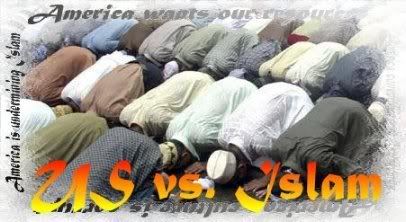
Large majorities across all four countries believe the United States seeks to “weaken and divide the Islamic world.” On average 79 percent say they perceive this as a US goal, ranging from 73 percent in Indonesia and Pakistan to 92 percent in Egypt. Equally large numbers perceive that the United States is trying to maintain “control over the oil resources of the Middle East” (average 79%). Strong majorities (average 64%) even believe it is a US goal to “spread Christianity in the region.”
“While US leaders may frame the conflict as a war on terrorism, people in the Islamic world clearly perceive the US as being at war with Islam,” said Steven Kull, editor of WorldPublicOpinion.org.
Far from being consistent with American right-wing claims that "Islamofascism" is a movement seeking "world domination," the poll indicates that the average Muslim wants to end US domination of the Islamic world, and supports some sort of military or paramilitary action to do so.
Consistent with this concern, large majorities in all countries (average 74%) support the goal of getting the United States to “remove its bases and military forces from all Islamic countries,” ranging from 64 percent in Indonesia to 92 percent in Egypt. Substantial numbers also favor attacks on US troops in Iraq, Afghanistan, and in the Persian Gulf. Across the four countries polled approximately half support such attacks in each location, while three in ten are opposed.
While there is significant support for some level of military action against what is seen as US military domination, there is little support for the typres of actions seen objectively as "terrorism."
Asked about politically-motivated attacks on civilians, such as bombings or assassinations, majorities in all countries—usually overwhelming majorities—take the strongest position offered by saying such violence cannot be justified at all. More than three out of four Indonesians (84%), Pakistanis (81%), and Egyptians (77%) take this position, as well as 57 percent of Moroccans (an additional 19 percent of Moroccans say such attacks can only be “weakly justified”).
More specifically, there is little support for al Qa'ida, except, ironically among our "allies" in Pakistan.
There is strong disapproval of attacks by “groups that use violence against civilians, such as al Qaeda.” Large majorities in Egypt (88%), Indonesia (65%) and Morocco (66%) agree that such groups “are violating the principles of Islam.” Pakistanis are divided, however, with many not answering.
While the poll indicated no significant level of support for terrorist groups, it did show that much of the Islamic world supports their goals.
Large majorities in all countries (average 70 percent or higher) support such goals as: “stand up to Americans and affirm the dignity of the Islamic people,” “push the US to remove its bases and its military forces from all Islamic countries,” and "pressure the United States to not favor Israel.”
None of this, however, indicates a desire in the Muslim world to isolate themselves from the larger world.
Asked how they feel about “the world becoming more connected through greater economic trade and faster communication,” majorities in all countries say it is a good thing (average 75%). While wary of Western values, overall 67 percent agree that “a democratic political system” is a good way to govern their country and 82 percent agree that in their country “people of any religion should be free to worship according to their own beliefs.”
Read the entire report here.
Terrorism is terrible enough, but the mindless, knee-jerk reaction to extirpate the evil is more discomforting. One visible result of the scramble to end terrorism is to take legal shortcuts and legal shortcuts always shrink the scope of human rights. These shortcuts have scarred the landscape of rights in the Philippines.Puno said that the institutional forces of anti-terrorism engage in much flag-waving, singing of the national anthem and issuing "high-pitched" directives to military forces, the police, and citizens to use their weapons for victory at all costs. But, he said, enough is enough. Security is meaningless at the expense of individual liberty.
To put constitutional cosmetics to the military-police muscular efforts, lawmakers usually enact laws using security of the state to justify the dimunition of human rights by allowing arrests without warrants; surveillance of suspects; interception and recording of communications; seizure or freezing of bank deposits, assets and records of suspects. They also redefine terrorism as a crime against humanity and the redefinition is broadly drawn to constrict and shrink further the zone of individual rights.Puno urged political leaders -- but the appeal might be read by all of us, if we choose -- to have a broader view of terrorism, saying poverty is also a form of terrorism and the poor suffer more by their poverty than by violence.
In poor countries, it is poverty that truly terrorizes people for they are terrorized by the thought that they will die because of empty stomachs and not that they will lose their lives due to some invisible suicide bombers...The apathy of those who can make a difference is the reason why violations of human rights continue to prosper. The worst enemy of human rights is not its non-believers but the fence sitters who will not lift a finger despite their violations...Sooner or later, they will find that they who default in protecting the rights of the many will end up without rights like the many...With the incursions and threats of incursion to our human rights at this crucial moment in our history, the clarion call to each one of us is to consecrate our lives to the great cause of upholding our human rights.

That's reminiscent of the August 6, 2001 Presidential Daily Briefing titled "Bin Laden Determined to Strike in US." Good Lord, how many dots do you have to draw in a straight line before it occurs to George W. Bush's administration to connect them???The newspaper says it has obtained 328 pages of classified documents that show foreign agents infiltrated al-Qaeda's network.
It produced nine reports between September 2000 and August 2001, including the January 2001 document called 'Plan to hijack an aircraft by Islamic radicals'.
Le Monde said the January 2001 report was handed over to a CIA operative in Paris, but that no mention of it was made in the official US September 11 Commission which produced its findings in July 2004.Why was that? Don't we deserve an explanation?
Le Monde said the documents also show the French believed al-Qaeda leader Osama bin Laden was still receiving help from family members and senior officials in Saudi Arabia in advance of the 11 September attacks.Yes. Like Pakistan's dictator Gen. Pervez Musharraf, the Saudis are our allies.

al-Baghdadi also claimed that al Qa'ida has set up facilities in Iraq to manufacture their own rockets.The largest batch of soldiers for jihad... in the history of Iraq are graduating and they have the highest level of competence in the world... From the military point of view, one of the (enemy) devils was right in saying that if Afghanistan was a school of terror, then Iraq is a university of terrorism.
The fear of the American Marines has disappeared from the hearts of the people of the world, as the mujahideen have become thousands from the few they were after the fall of the infidel Baath regime. These are just some of the achievements of four years of jihad.
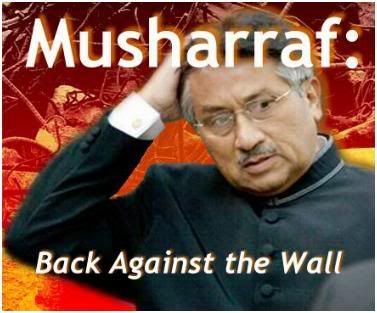
Let me repeat and emphasize that last part: Terrorism is a state of mind that cannot be countered with force and needs a long-term strategy and total understanding of its underlying causes.President Musharraf urged the developed and industrialized States to help the Islamic countries in their socio-economic development as the extremism stems from poverty.
The President re-emphasized Pakistan's firm resolve to combat terrorism frontally and militarily but said that joint efforts were needed by the global community in achieving the objective of defeating the menace. He pointed out that extremism is a state of mind and could not be countered with force and needs a long-term strategy and total understanding of underlined causes which spawn the scourge.
The President said that the poverty, illiteracy and misinterpretation of Islamic knowledge are the other inherent causes contributing to the rise of extremism.Yes. Pakistan has only a 48% literacy rate -- 35% female literacy. Perhaps Musharraf will funnel some money into educating Pakistan's citizens? A quarter of Pakistan lives below the poverty level -- the Pakistani poverty level. Child labor is common there. Pakistan has a per capita gross domestic product of $2,600. To put that into perspective, Iraq -- in the midst of a bloody civil war, mounting insurgency, and daily chaos, has a per capita GDP of $2,900.
(Musharraf) said two-pronged strategy on the one hand calls upon the Muslim States to shun extremism and go on the path of socio-economic development and on the other called upon the West, especially the United States , to help resolve outstanding disputes and assist in economic development of Islamic countries. (my emphasis)Like it or not, folks, we are our brothers' keeper. From those to whom much is given, much is expected.
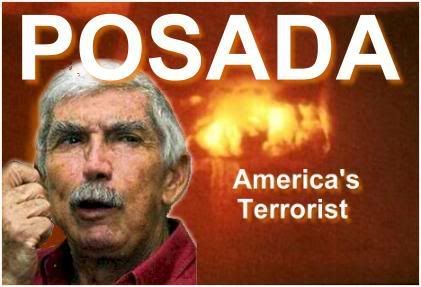
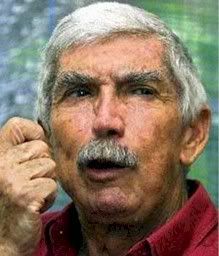
"I'm outraged,'' said Iliana Alfonso, whose father was among those killed on the Cubana de Aviacion flight that exploded off Barbados. "In the United States, they are talking about good terrorism and bad terrorism. To me, all terrorism is bad.''Welcome to the United States of America as envisioned by George W. Bush and the Project for a New American Century. The point Ms. Alfonse is missing is that the US is inherently good, and any act undertaken in our interest is inherently good. So, yes, we can point to bad terrorists and we can celebrate our own good terrorists. Or so the logic goes...
Still, Ms. Alfonso stubbornly insists on making moral judgments:
It is not ethical to unleash wars against terrorism, provoking the deaths of thousands of citizens in distant parts of the world while sheltering in its own territory terrorists who are self-confessed and still active.
Again, ethics has nothing to do with it. We are, by definition, right, so anything we do is right. That is the value system we're working within in the neo-con mindset. Oh, and Democracy? The idea of government being responsive to "will of the people?"Don't hold your breath. And laws?
The Venezuelan Foreign Ministry on Wednesday also slammed the U.S. court decision, accusing the United States of protecting a "terrorist.''
And they're right. We are harboring a terrorist, much to our shame (well, I'm ashamed we're harboring a terrorist, but I don't know if you are. But you ought to be). George W. Bush has brought shame and disgrace on the United States of America.
HE SHOULD BE IMPEACHED.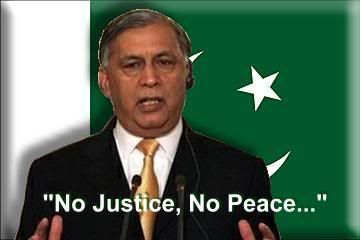
He suggested a comprehensive, "Marshall Plan"-type program, where those people most effected are given a stake in their own development.There must be respect for human rights and fundamental freedom because the denial of justice, torture, humiliation and collateral damage can only be counterproductive.
We need to adopt a holistic approach to address a conflict situation by providing hope and opportunity to the people, engaged in reconstruction and rehabilitation and provide employment opportunities.
We must remove all hurdles and obstacles to development programmes, especially in conflict situations.
I realise I can be arrested. I realise that like the assassination of Philippines Senator Benigno Aquino in Manila in August 1983, I can be gunned down on the airport tarmac when I land. After all, Al-Qaida has tried to kill me several times, why would we think they wouldn't try again as I return from exile to fight for the democratic elections they so detest?
But I do what I have to do, and I am determined to return to fullfil my pledge to the people of Pakistan to stand by them in their democratic aspirations.
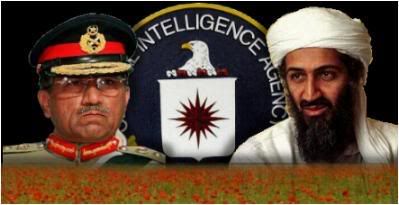
He is essentially commanding a force of several hundred guerrilla fighters that stage attacks across the border into Iran on Iranian military officers, Iranian intelligence officers, kidnapping them, executing them on camera. He used to fight with the Taliban. He’s part drug smuggler, part Taliban, part Sunni activist.This is the latest in a number of suspicious circumstances involving our "new best friend," Pakistan, led by despotic tyrant and dictator Gen. Pervez Musharraf. Those circumstances center on Pakistan's intelligence service, the ISI, the CIA, Osama bin Laden, and the Taliban, once allies in the jihad against Soviet occuption of Afghanistan, all living quite comfortably now in Pakistan.
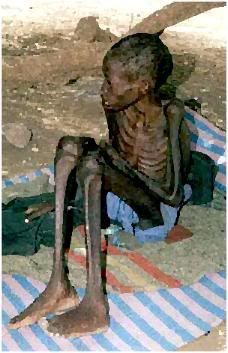
This era of global apathy and global greed has to end. This era of global, un-regulated, laissez faire, "free-market" capitalism has to end. Rational regulation was just as much a part of Adam Smith's vision as irrational speculation.Whenever the Government supports laws to combat global terrorism, it routinely invokes UN guidelines on the subject as a rationale, even when that sometimes means restricting the civil liberties of New Zealanders. Yet when it comes to UN initiatives aimed at combating global poverty, the Government has been willing to drag its feet.
In years past, the Prime Minister Helen Clark has acknowledged the links that exist between terrorism and its breeding grounds in poverty, inequality, disease and lack of opportunity. The Government should be treating global poverty with the same urgency it currently affords to global terrorism.
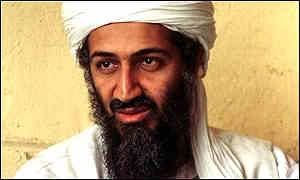
The new leaders rose from within the organization after the death or capture of the operatives that built Al Qaeda before the Sept. 11, 2001, attacks on the United States. This has led to surprise and dismay within U.S. intelligence agencies about the group's ability to rebound from an American-led offensive.Perhaps if we had maintained that offensive pressure -- and exerted some pressure on the likes of Pakistan's dictator Gen. Pervez Musharraf -- instead of bailing out to fight an unnecessary war in Iraq, we wouldn't be feeling all this "surprise" and "dismay."
The evidence officials said was accumulating about (ascending terrorist leader Abu Ubaidah al-)Masri and a handful of other Al Qaeda figures has led to a reassessment within the U.S. intelligence community about the strength of the group's core in Pakistan's tribal areas, and its role in some of the most significant terrorism plots of the last two years, including the airline plot and the suicide attacks in London in July 2005 that killed 56 people.So al Qa'ida has survived the "American-led offensive" (which included the "fumbled" opportunity at Tora Bora) in Afghanistan, they have a safe haven in Pakistan, and --SURPRISE!!! -- they have gained a foothold in Iraq.
Yes. Thanks to George W. Bush and his friends, like Pakistan dictator Pervez Musharraf.Experts say they still see Al Qaeda in Mesopotamia as largely independent of Al Qaeda's hub in Pakistan but that they believe the fighting in Iraq will produce future al Qaeda leaders. "The jihadis returning from Iraq are far more capable than the mujahedeen who fought the Soviets ever were," said Robert Richer, who was associate director of operations in 2004 and 2005 for the CIA. "They have been fighting the best military in the world, with the best technology and tactics."
"To say that Al Qaeda was out of business simply because they have not attacked in the U.S. is whistling past the graveyard," said Michael Scheuer, a former head of the bin Laden tracking unit at the CIA. "Al Qaeda is still humming along, and with a new
generation of leaders."

